Civil Services Examination · Question 69
With reference to the religious history of medieval India, the Sufi mystics were known to pursue which of the following practices? 1. Meditation and control of breath 2. Severe ascetic exercises in a lonely place 3. Recitation of holy songs to arouse a state of ecstasy in their audience Select the correct answer using the codes given below :
Show answer & explanationShow explanation
Answer: (D) 1, 2 and 3
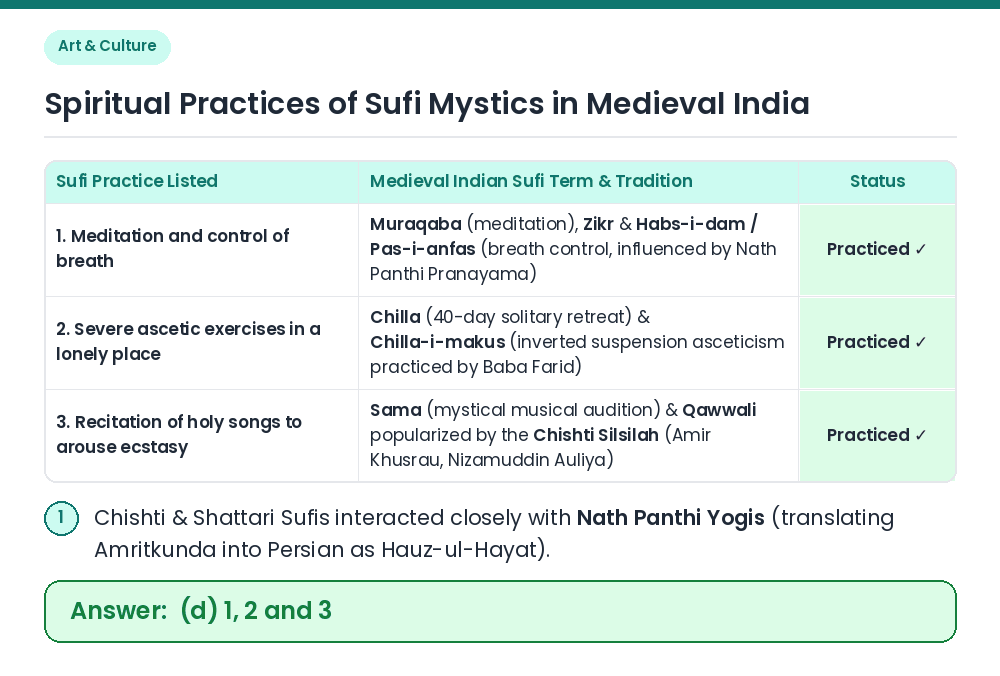
Given / Concept: Sufi mystics in medieval India (especially the Chishti and Shattari Silsilahs) adopted intensive spiritual, yogic, and musical practices to attain union (Wasl/Fana) with God. Practice 1 & 2 Analysis: Sufi saints practiced meditation (Muraqaba), repetition of divine names (Zikr), and regulation of breath (Habs-i-dam / Pas-i-anfas, influenced by Hatha Yoga Pranayama) (1), along with severe ascetic retreats in lonely places such as the 40-day solitary 'Chilla' and 'Chilla-i-makus' (2) ⇒ Statements 1 and 2 are correct. Practice 3 Analysis: Chishti Sufis famously practiced 'Sama'—the recitation of mystical devotional songs (Qawwali) to induce a state of spiritual ecstasy (Wajd / Hal) in their audience (3) ⇒ Statement 3 is correct. Result: All three practices (1, 2 and 3) were pursued by Sufi mystics in medieval India. Related Facts: Key Sufi Silsilahs and Figures in Medieval India: • Chishti Silsilah: Founded in India by Khwaja Moinuddin Chishti (Ajmer); followed by Qutbuddin Bakhtiyar Kaki, Baba Farid, Nizamuddin Auliya, and Nasiruddin Chiragh-i-Dehlavi. • Yoga–Sufi Synthesis: Nizamuddin Auliya was so skilled in yogic breath control that Yogis called him a 'Siddha' (perfect master); Shattari saint Muhammad Ghaus Gwaliyari wrote 'Bahr-ul-Hayat' on yogic postures. • Suhrawardi & Naqshbandi Silsilahs: Bahauddin Zakariya led the Suhrawardi order in Multan; Shaikh Ahmad Sirhindi led the orthodox Naqshbandi order (which opposed Sama). Correct Answer: (d) 1, 2 and 3