Civil Services Examination · Question 72
Lord Buddha's image is sometimes shown with the hand gesture called 'Bhumisparsha Mudra'. It symbolizes
Show answer & explanationShow explanation
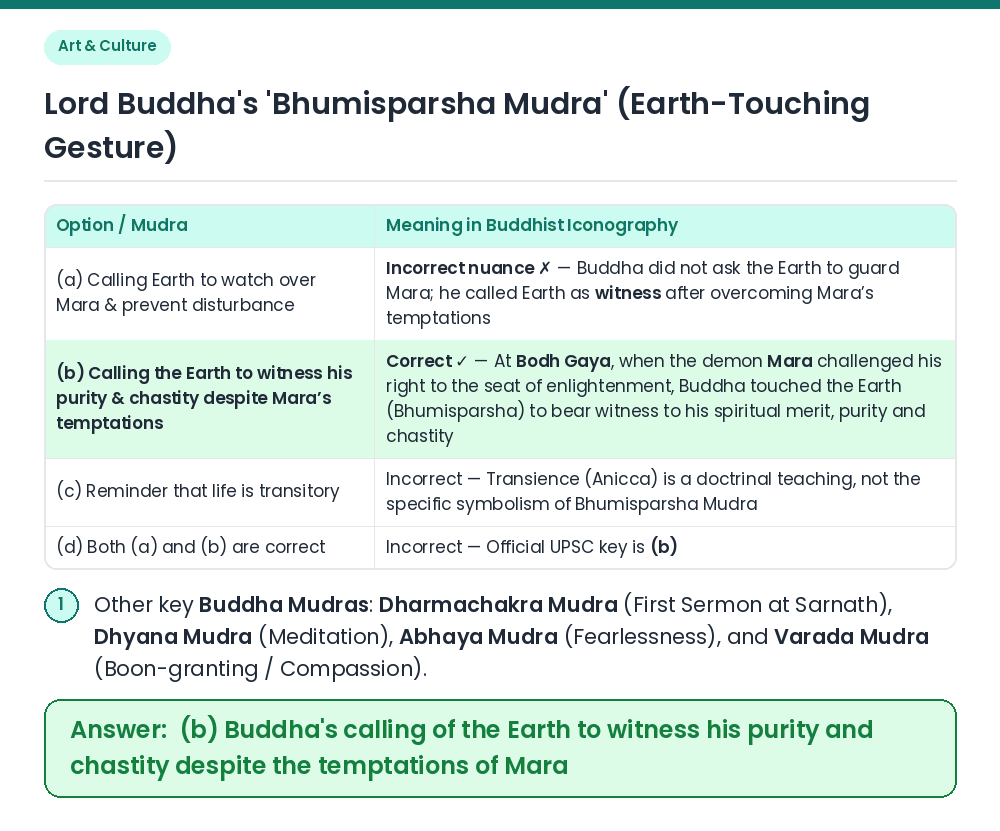
Answer: (B) Buddha's calling of the Earth to witness his purity and chastity despite the temptations of Mara
Given / Concept: In Buddhist iconography, 'Bhumisparsha Mudra' (literally 'earth-touching gesture') depicts the seated Buddha with his left hand in his lap (palm upright) and his right hand hanging over his right knee, fingers touching the ground. Symbolism at Bodh Gaya: Just before his enlightenment under the Bodhi tree at Bodh Gaya, the demon king Mara assailed Siddhartha Gautama with armies and temptations and challenged his right to attain enlightenment, asking who would bear witness for him. Buddha touched the ground with his right fingertips, calling the Earth Goddess (Sthavara / Prithvi) to witness his purity, chastity, and accumulated merit (Paramitas) despite Mara's temptations ⇒ Option (b) is the exact meaning. Why Option [a] & [d] fail: Buddha himself resisted Mara through inner spiritual resolve; he called the Earth as a witness (Sakshi) to his purity, not as a guard to watch over Mara ⇒ Option (a) is inaccurate, making (b) the correct choice. Result: Bhumisparsha Mudra symbolizes Buddha's calling of the Earth to witness his purity and chastity despite the temptations of Mara. Related Facts: Major Mudras in Buddhist Iconography: • Dharmachakra Mudra: Turning the Wheel of Law; represents Buddha's first sermon at Sarnath. • Dhyana (Samadhi) Mudra: Both hands resting in the lap, palms facing upward; signifies deep meditation. • Abhaya Mudra: Right hand raised to shoulder height with palm facing outward; signifies fearlessness and protection. • Varada Mudra: Palm facing outward with fingers pointing downward; signifies charity, compassion, and boon-granting. Correct Answer: (b) Buddha's calling of the Earth to witness his purity and chastity despite the temptations of Mara