Civil Services Examination · Question 75
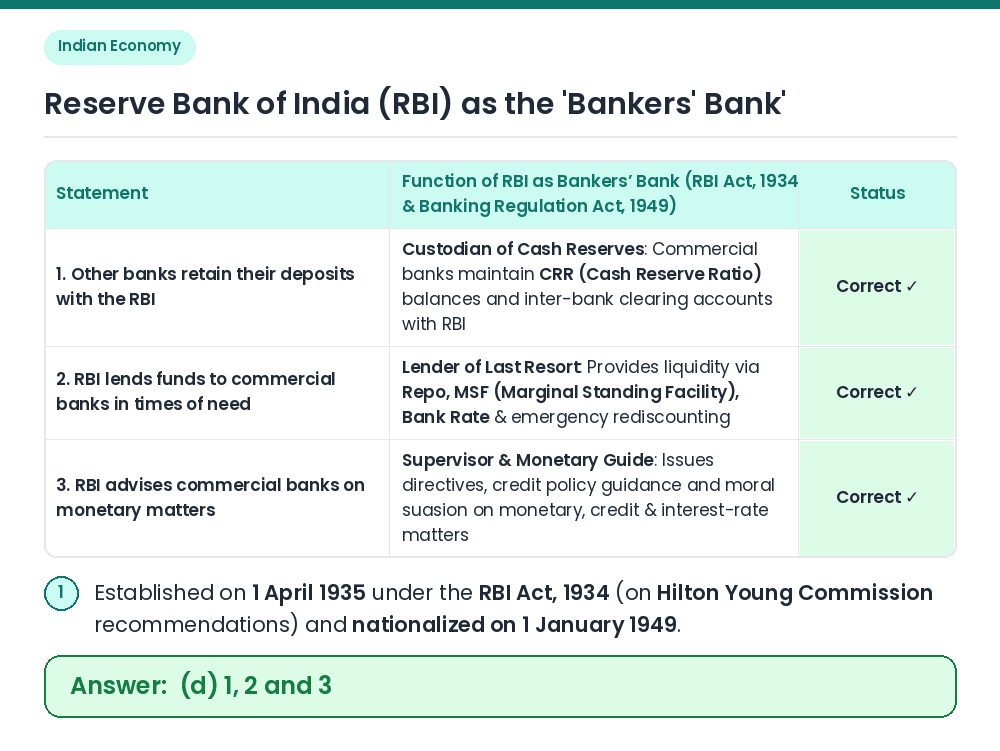
The Reserve Bank of India (RBI) acts as a bankers' bank. This would imply which of the following? 1. Other banks retain their deposits with the RBI. 2. The RBI lends funds to the commercial banks in times of need. 3. The RBI advises the commercial banks on monetary matters. Select the correct answer using the codes given below :
Show answer & explanationShow explanation
Answer: (D) 1, 2 and 3
Given / Concept: As India's central bank, the Reserve Bank of India (RBI) stands in the same relation to commercial banks as commercial banks stand to their customers—acting as the 'Bankers' Bank'. Statements 1 & 2 Analysis: Scheduled commercial banks are required to hold a specified fraction of their Net Demand and Time Liabilities (NDTL) as Cash Reserve Ratio (CRR) deposits with the RBI for reserve and central clearing purposes (1), and RBI acts as the 'Lender of Last Resort' by lending funds to commercial banks in times of liquidity need through Repo, MSF, and rediscounting of bills (2) ⇒ Statements 1 and 2 are correct. Statement 3 Analysis: Under the RBI Act, 1934 and Banking Regulation Act, 1949, RBI also guides and advises commercial banks on monetary, credit, and regulatory matters (including Moral Suasion) (3) ⇒ Statement 3 is correct. Result: All three statements (1, 2 and 3) are implied by RBI acting as a bankers' bank. Related Facts: Core Functions of the Reserve Bank of India: • Monetary Authority & Sole Issuer of Currency: Formulates monetary policy (via the 6-member Monetary Policy Committee under Section 45ZB) and has the sole monopoly to issue currency notes above ₹1 (under Section 22 of RBI Act, 1934). • Banker to the Government: Manages public debt and acts as banker, agent, and financial adviser to the Central and State Governments (Sections 20 & 21). • Custodian of Foreign Exchange Reserves: Manages India's forex reserves and stabilizes the external value of the rupee. Correct Answer: (d) 1, 2 and 3