Civil Services Examination · Question 77
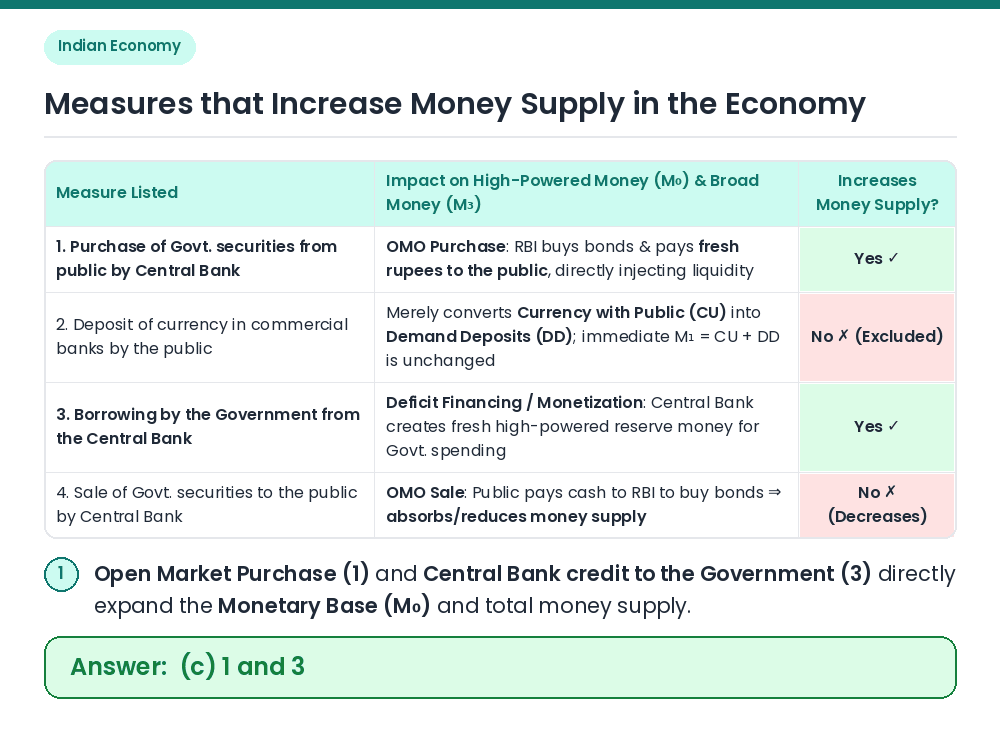
Which of the following measures would result in an increase in the money supply in the economy? 1. Purchase of government securities from the public by the Central Bank 2. Deposit of currency in commercial banks by the public 3. Borrowing by the government from the Central Bank 4. Sale of government securities to the public by the Central Bank Select the correct answer using the codes given below :
Show answer & explanationShow explanation
Answer: (C) 1 and 3
Given / Concept: Money supply in an economy expands when the Central Bank injects fresh high-powered money (Reserve Money, M₀) into circulation. Statements 1 & 3 Analysis: When the Central Bank purchases government securities from the public under Open Market Operations (1), it pays money directly into the economy; similarly, when the government borrows from the Central Bank and spends it (3), new high-powered money enters circulation ⇒ Statements 1 and 3 increase money supply. Statements 2 & 4 Analysis: Sale of government securities by the Central Bank sucks liquidity out of the economy and decreases money supply (4). Depositing cash in commercial banks (2) merely shifts money from 'Currency with the public' (CU) to 'Deposits' (DD) without an immediate central-bank injection (and any option with 2 in this question also includes 4, which is definitely false) ⇒ 2 and 4 are excluded. Result: Measures 1 and 3 result in an increase in the money supply. Related Facts: Expansionary vs Contractionary Monetary Policy Tools: • Expansionary (Increases Money Supply): OMO Purchase of G-Secs, lowering Repo Rate/Bank Rate, and lowering CRR/SLR. • Contractionary (Decreases Money Supply): OMO Sale of G-Secs, raising Repo Rate/Bank Rate, and raising CRR/SLR. • Money Supply Aggregates in India: M₀ (Reserve Money), M₁ (Narrow Money = CU + DD + OD), and M₃ (Broad Money = M₁ + Time Deposits with banks). Correct Answer: (c) 1 and 3