Civil Services Examination · Question 76
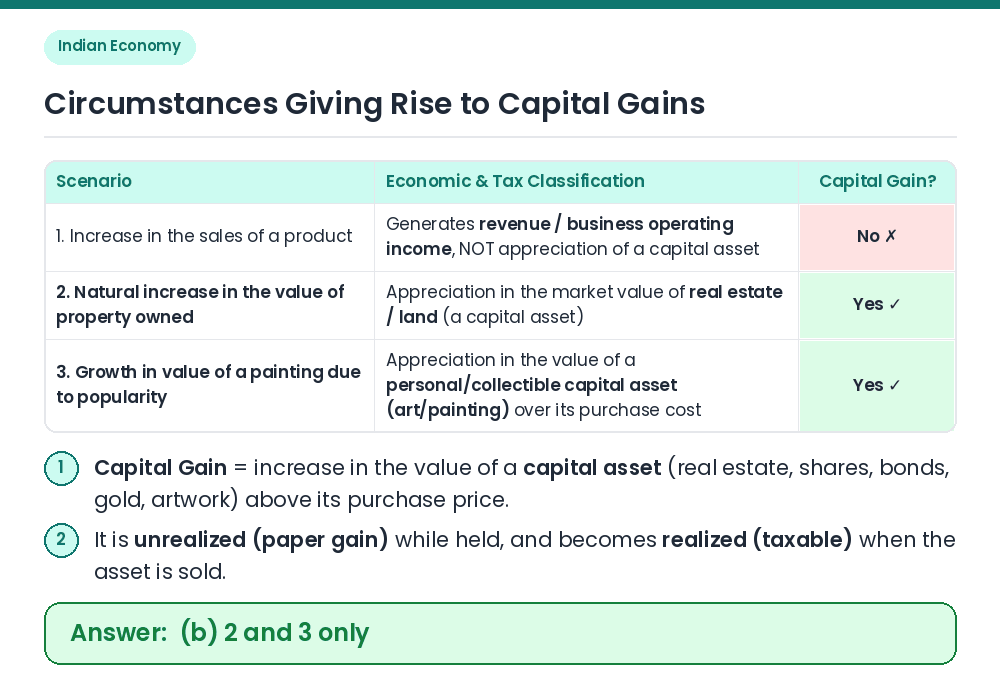
Under which of the following circumstances may 'capital gains' arise? 1. When there is an increase in the sales of a product 2. When there is a natural increase in the value of the property owned 3. When you purchase a painting and there is a growth in its value due to increase in its popularity Select the correct answer using the codes given below :
Show answer & explanationShow explanation
Answer: (B) 2 and 3 only
Given / Concept: A capital gain is the rise in the market value of a capital asset (such as land, buildings, equity shares, bonds, gold, or fine art) above its original purchase price (cost of acquisition). Statement 1 Analysis: An increase in the sales of a commercial product generates ordinary business revenue/operating profit, not a capital gain ⇒ Statement 1 is incorrect. Statement 2 & 3 Analysis: A natural appreciation in the value of real estate property owned (2) and an increase in the value of a purchased painting due to rising popularity (3) both represent appreciation in the value of capital assets ⇒ Statements 2 and 3 are correct. Result: Capital gains arise under circumstances 2 and 3 only. Related Facts: Key facts on Capital Gains in India (Income Tax Act, 1961): • Capital Assets (Section 2(14)): Includes land, buildings, securities, jewellery, archaeological collections, drawings, paintings, and sculptures. • Short-Term vs Long-Term Capital Gains: Assets held beyond a specified holding period (12/24 months) qualify for Long-Term Capital Gains (LTCG), while shorter holdings yield Short-Term Capital Gains (STCG). • Realized vs Unrealized Gain: Capital gain is 'unrealized' while the asset is held and becomes 'realized' (and subject to Capital Gains Tax) upon transfer/sale. Correct Answer: (b) 2 and 3 only