Civil Services Examination · Question 67
With reference to Dhrupad, one of the major traditions of India that has been kept alive for centuries, which of the following statements are correct? 1. Dhrupad originated and developed in the Rajput kingdoms during the Mughal period. 2. Dhrupad is primarily a devotional and spiritual music. 3. Dhrupad Alap uses Sanskrit syllables from Mantras. Select the correct answer using the codes given below :
Show answer & explanationShow explanation
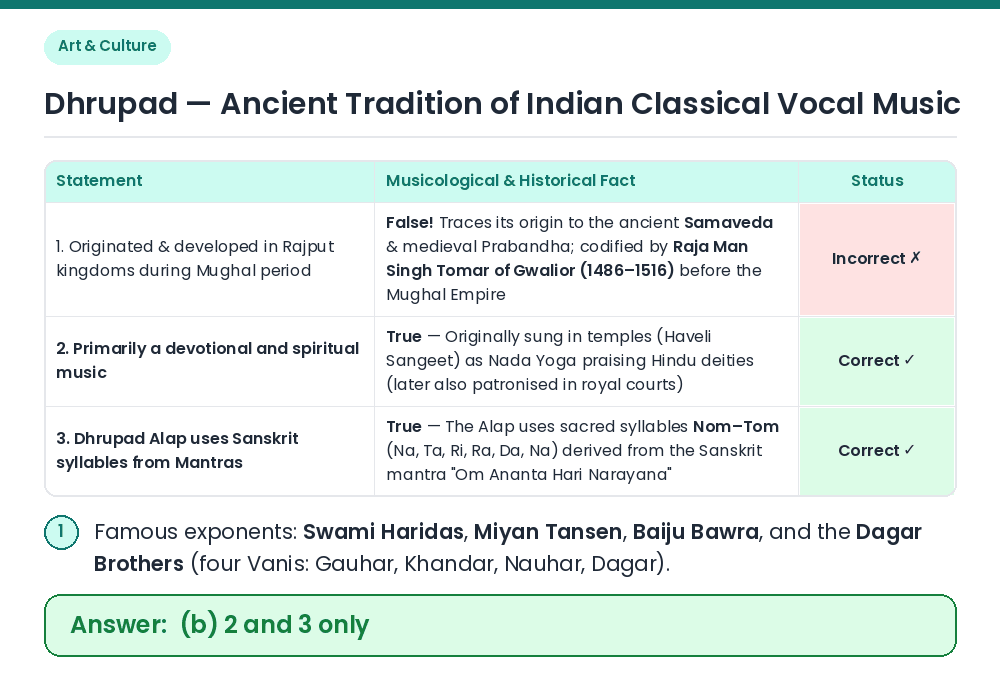
Answer: (B) 2 and 3 only
Given / Concept: Dhrupad (from 'Dhruva' = fixed + 'Pada' = verse) is the oldest surviving vocal genre of Hindustani classical music. Statement 1 Analysis: Dhrupad did NOT originate during the Mughal period; its roots go back to the ancient Samaveda chants and Natyashastra/Prabandha traditions, and it reached its classic form under Raja Man Singh Tomar of Gwalior (1486–1516) prior to the establishment of the Mughal Empire in 1526 ⇒ Statement 1 is incorrect. Statement 2 & 3 Analysis: Dhrupad is fundamentally a solemn, devotional, and spiritual form of music (originally sung in temples before deities) (2), and its unaccompanied introductory 'Alap' uses syllables (like Nom, Tom, Ri, Ra, Na) derived from the Sanskrit mantra 'Om Ananta Taranam Tarini Twam Hari Om Narayana' (3) ⇒ Statements 2 and 3 are correct. Result: Statements 2 and 3 only are correct. Related Facts: Key facts about Dhrupad Music: • Accompaniment: Traditionally accompanied by the Pakhawaj (barrel drum) and Tanpura. • Four Vanis (Styles): Gauhar Vani (associated with Tansen), Dagur/Dagar Vani (associated with Swami Haridas / Brij Chand), Khandar Vani, and Nauhar Vani. • Structure: Consists of an elaborate rhythmic/unmetered Alap (Alap, Jod, Jhala) followed by the four-part composition: Sthayi, Antara, Sanchari, and Abhog. Correct Answer: (b) 2 and 3 only