Civil Services Examination · Question 65
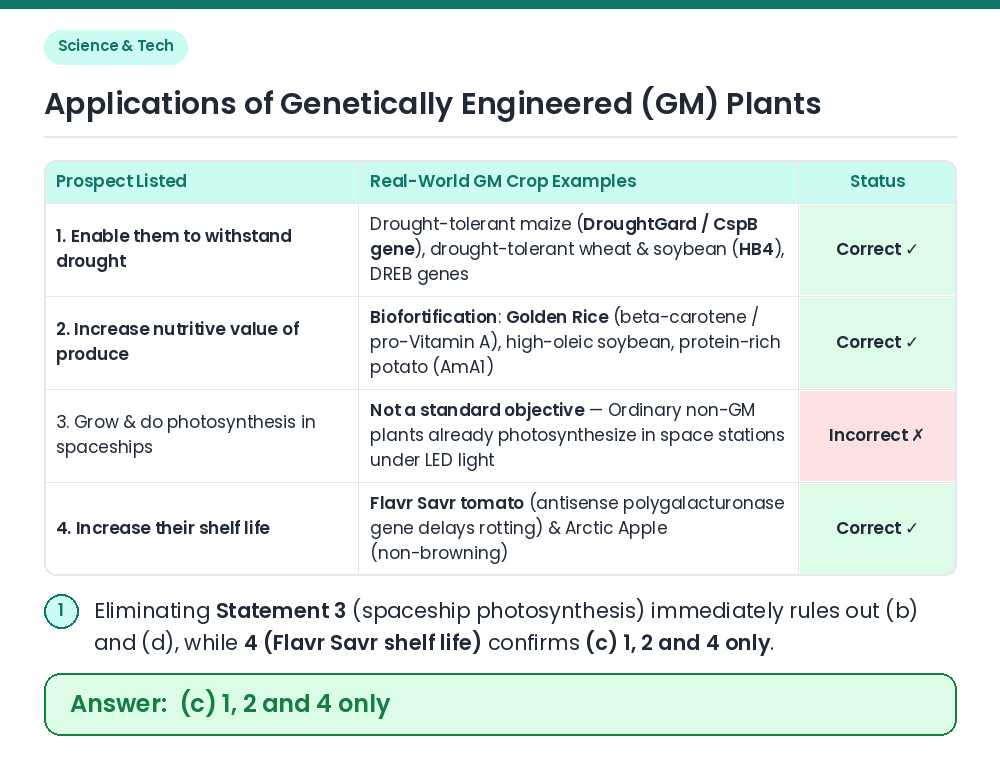
Other than resistance to pests, what are the prospects for which genetically engineered plants have been created? 1. To enable them to withstand drought 2. To increase the nutritive value of the produce 3. To enable them to grow and do photosynthesis in spaceships and space stations 4. To increase their shelf life Select the correct answer using the codes given below :
Show answer & explanationShow explanation
Answer: (C) 1, 2 and 4 only
Given / Concept: Genetic engineering in plants targets abiotic stress tolerance, nutritional biofortification, herbicide tolerance, and post-harvest quality improvement. Statements 1, 2 & 4 Analysis: Transgenic plants have been created for drought/salinity tolerance using osmoregulatory/DREB genes (1), enhanced nutritional value such as Vitamin-A enriched Golden Rice and protein-rich AmA1 potato (2), and extended shelf life such as the Flavr Savr tomato with suppressed polygalacturonase enzyme (4) ⇒ Statements 1, 2 and 4 are correct. Statement 3 Analysis: Ordinary non-GM plants already grow and perform photosynthesis aboard space stations (such as ISS 'Veggie' chambers) when provided light, water, and nutrients; genetic engineering was not created to enable photosynthesis in space ⇒ Statement 3 is incorrect. Result: Statements 1, 2 and 4 only are correct. Related Facts: Landmark Genetically Engineered Crops: • Flavr Savr Tomato (1994): First commercially grown GM food granted a license for human consumption; used antisense RNA to inhibit the fruit-softening enzyme polygalacturonase. • Golden Rice (Ingo Potrykus & Peter Beyer): Engineered with phytoene synthase (psy) from daffodil/maize and crtI from Erwinia uredovora to synthesize beta-carotene (Vitamin A precursor) in rice endosperm. • Herbicide Tolerance: Roundup Ready crops (soybean, maize, canola) engineered to tolerate glyphosate herbicide. Correct Answer: (c) 1, 2 and 4 only