Civil Services Examination · Question 86
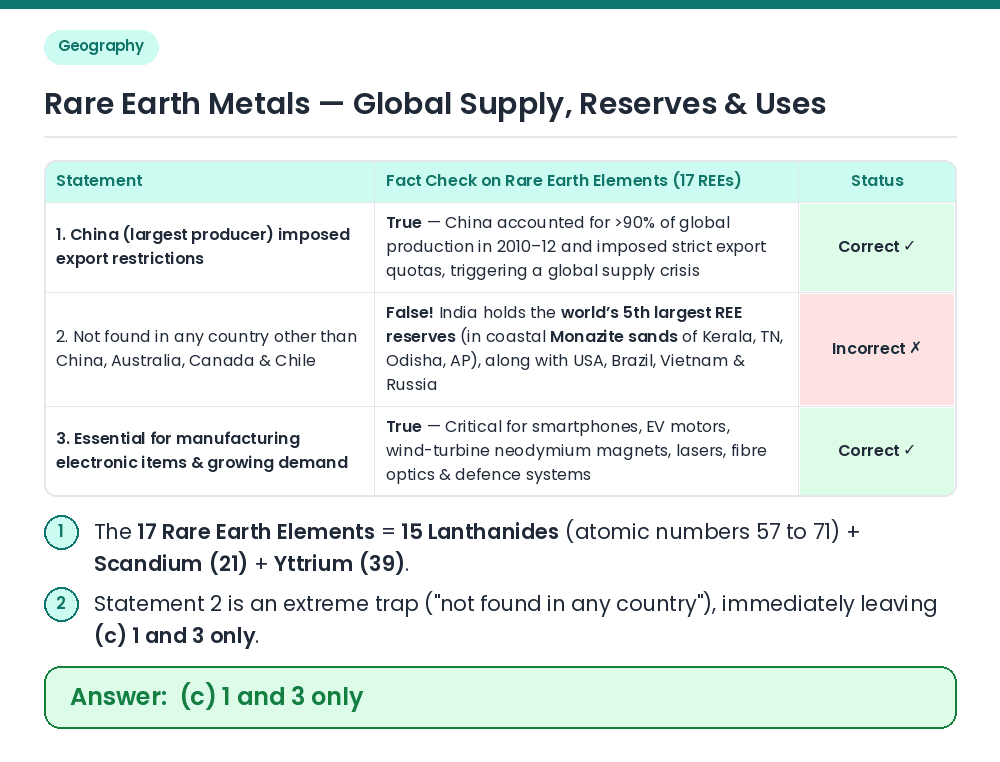
Recently, there has been a concern over the short supply of a group of elements called 'rare earth metals'. Why? 1. China, which is the largest producer of these elements, has imposed some restrictions on their export. 2. Other than China, Australia, Canada and Chile, these elements are not found in any country. 3. Rare earth metals are essential for the manufacture of various kinds of electronic items and there is a growing demand for these elements. Which of the statements given above is/are correct?
Show answer & explanationShow explanation
Answer: (C) 1 and 3 only
Given / Concept: Rare Earth Metals (Rare Earth Elements, REEs) are a set of 17 metallic elements (15 lanthanides plus scandium and yttrium) crucial for clean energy and high-tech electronics. Statement 1 & 3 Analysis: China, the world's largest producer and refiner of rare earth metals, imposed strict export quotas/restrictions around 2010–2012 (1), while global demand surged because REEs are indispensable for manufacturing smartphones, displays, electric vehicle motors, wind turbines, and defence electronics (3) ⇒ Statements 1 and 3 are correct. Statement 2 Analysis: Rare earth elements are found in many other countries including India (which has the world's 5th largest reserves in coastal monazite sands), the USA, Brazil, Vietnam, and Russia ⇒ Statement 2 is incorrect. Result: Statements 1 and 3 only are correct. Related Facts: Key facts about Rare Earth Elements (REEs): • Why called 'Rare': They are actually moderately abundant in the Earth's crust (cerium is more abundant than copper), but rarely occur in concentrated, economically minable ore deposits. • India's Reserves & PSU: India holds ~6.9 million tonnes of REE reserves (mainly in monazite beach sands along Kerala, Tamil Nadu, Odisha, and Andhra Pradesh), mined and processed by IREL (India) Limited (formerly Indian Rare Earths Limited) under the Department of Atomic Energy. • Key Applications: Neodymium and Dysprosium (permanent magnets for EVs and wind turbines), Europium and Terbium (phosphors in LEDs/screens), and Lanthanum (NiMH batteries and camera lenses). Correct Answer: (c) 1 and 3 only