Civil Services Examination · Question 83
The distribution of powers between the Centre and the States in the Indian Constitution is based on the scheme provided in the
Show answer & explanationShow explanation
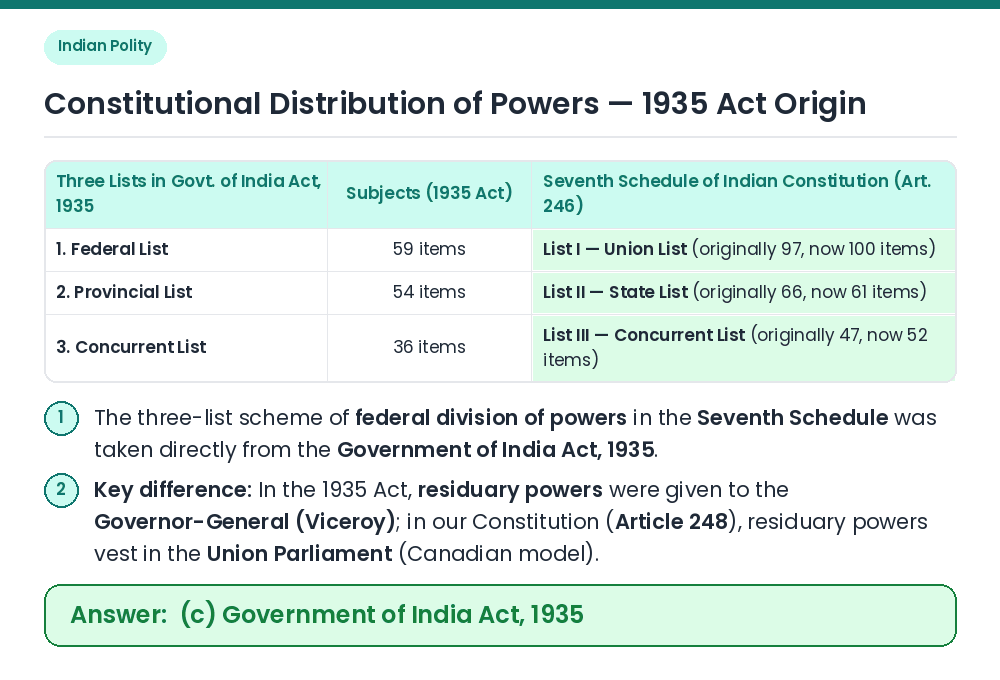
Answer: (C) Government of India Act, 1935
Given / Concept: Article 246 and the Seventh Schedule of the Indian Constitution divide legislative powers between the Centre and the States across three lists: Union List, State List, and Concurrent List. Origin in the 1935 Act: This three-fold division of powers is modeled directly on the Government of India Act, 1935, which divided subjects into the Federal List (59 items), Provincial List (54 items), and Concurrent List (36 items) ⇒ Option (c) is correct. Elimination of Other Acts: The 1909 Act dealt only with legislative council expansion and separate electorates; the 1919 Act introduced provincial dyarchy with two lists (Central and Provincial, without a Concurrent List); and the 1947 Act partitioned British India into two independent Dominions. Result: The distribution of powers between the Centre and the States is based on the scheme provided in the Government of India Act, 1935. Related Facts: Key features borrowed from the Government of India Act, 1935: • Structural Framework: Federal scheme, Three Lists (Seventh Schedule), Office of the Governor, Federal Judiciary, Public Service Commissions, Emergency provisions, and administrative details. • Residuary Powers Contrast: Under the 1935 Act, residuary legislative powers were vested in the Viceroy/Governor-General; under Article 248 of the Indian Constitution (inspired by Canada), residuary powers are vested in the Union Parliament. Correct Answer: (c) Government of India Act, 1935