Civil Services Examination · Question 90
In which one among the following categories of protected areas in India are local people not allowed to collect and use the biomass?
Show answer & explanationShow explanation
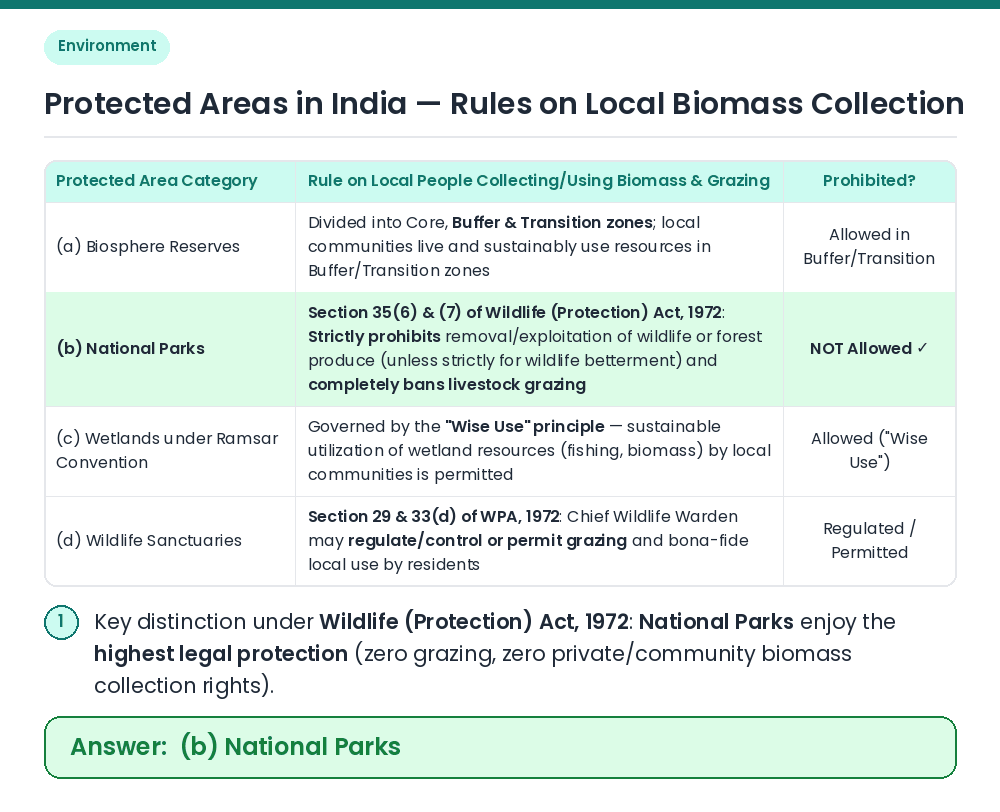
Answer: (B) National Parks
Given / Concept: Different categories of protected areas in India have varying degrees of legal restrictions on human entry, grazing, and collection of forest produce (biomass). National Parks — Strict Prohibition: Under Section 35(6) and 35(7) of the Wildlife (Protection) Act, 1972, no person is allowed to destroy, exploit, or remove any wildlife or forest produce (biomass) from a National Park (except when authorized by the State Government strictly for the improvement and better management of wildlife therein), and no grazing of any livestock is permitted ⇒ Option (b) is correct. Comparison with Other Categories: In Wildlife Sanctuaries (d), limited grazing and local rights may be regulated/permitted by the Chief Wildlife Warden; in Biosphere Reserves (a), sustainable resource use is allowed in the Buffer and Transition zones; and Ramsar Wetlands (c) operate on the 'Wise Use' principle allowing sustainable local livelihoods. Result: Local people are not allowed to collect and use biomass in National Parks. Related Facts: Key legal distinctions under the Wildlife (Protection) Act, 1972: • National Park vs Wildlife Sanctuary: A National Park is declared for protecting the entire ecosystem/habitat (not focused on a single species), has fixed boundaries altered only on NBWL recommendation, and extinguishes all private/grazing rights; a Wildlife Sanctuary can be species-oriented and permits regulated grazing. • First National Park in India: Hailey National Park (established in 1936), now known as Jim Corbett National Park (Uttarakhand). • Other WPA Categories (Added in 2002): Conservation Reserves (Section 36A) and Community Reserves (Section 36C). Correct Answer: (b) National Parks