Civil Services Examination · Question 94
The Millennium Ecosystem Assessment describes the following major categories of ecosystem services—provisioning, supporting, regulating, preserving and cultural. Which one of the following is supporting service?
Show answer & explanationShow explanation
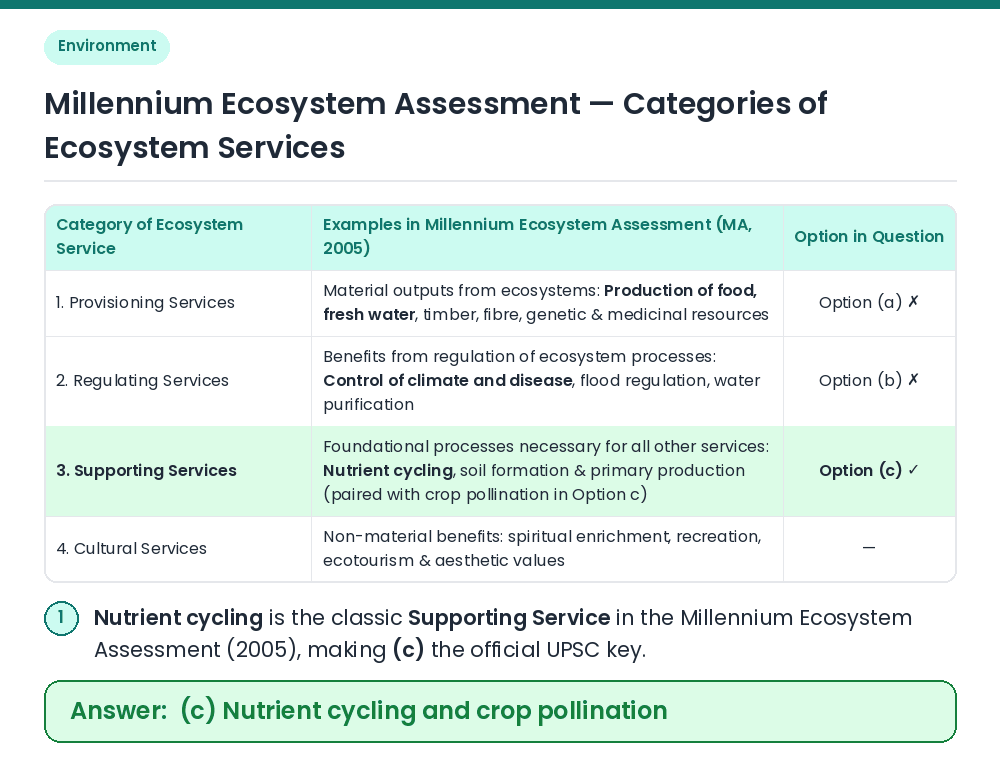
Answer: (C) Nutrient cycling and crop pollination
Given / Concept: The UN Millennium Ecosystem Assessment (MA, 2005) classified ecosystem services into four main functional categories: Provisioning, Regulating, Supporting, and Cultural services. Identifying the Categories: (a) 'Production of food and water' is a Provisioning service; (b) 'Control of climate and disease' is a Regulating service. Supporting Service Analysis: Supporting services are the underlying ecological processes necessary for the production of all other ecosystem services—most notably 'Nutrient cycling', soil formation, and primary production ⇒ Option (c) 'Nutrient cycling and crop pollination' is the official UPSC key (Note: in strict MA taxonomy, nutrient cycling is a supporting service while pollination is grouped under regulating services, but because nutrient cycling is a quintessential supporting service, (c) is the intended and official answer). Result: Nutrient cycling and crop pollination (c) represents the supporting service. Related Facts: Summary of the Four Ecosystem Service Categories (MA, 2005): • Provisioning Services: Products obtained from ecosystems (food, freshwater, fuelwood, fiber, biochemicals, genetic resources). • Regulating Services: Benefits obtained from regulation of ecosystem processes (climate regulation, disease regulation, water purification, erosion control). • Supporting Services: Services necessary for the production of all other ecosystem services (soil formation, nutrient cycling, primary production, oxygen production). • Cultural Services: Non-material benefits (spiritual, religious, recreation, ecotourism, aesthetic, educational). Correct Answer: (c) Nutrient cycling and crop pollination