Civil Services Examination · Question 99
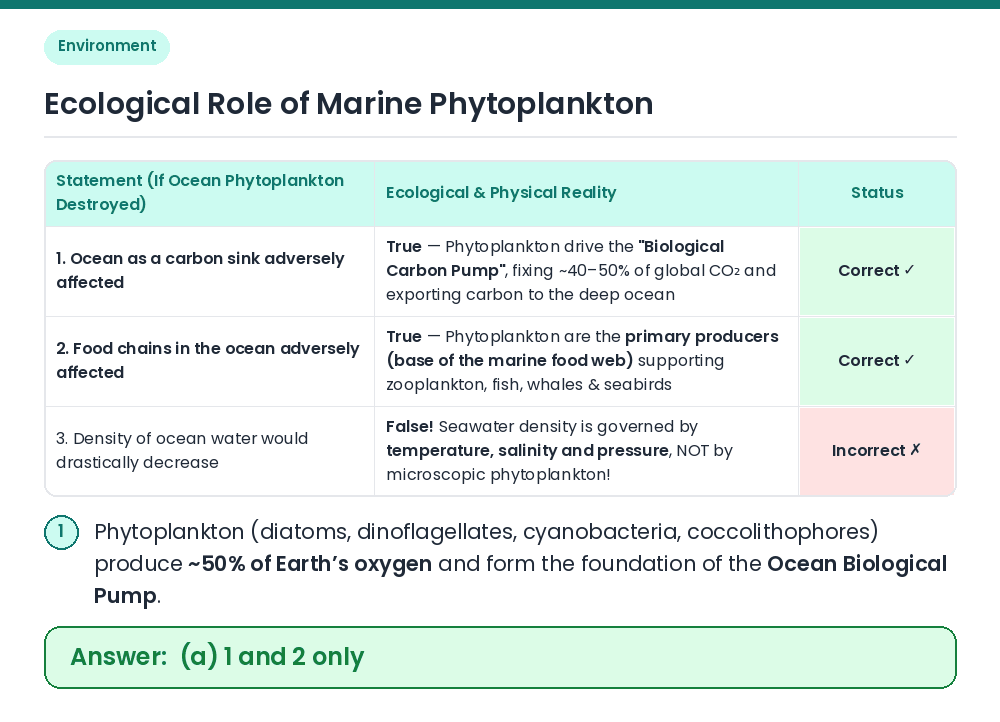
What would happen if phytoplankton of an ocean is completely destroyed for some reason? 1. The ocean as a carbon sink would be adversely affected. 2. The food chains in the ocean would be adversely affected. 3. The density of ocean water would drastically decrease. Select the correct answer using the codes given below :
Show answer & explanationShow explanation
Answer: (A) 1 and 2 only
Given / Concept: Phytoplankton are microscopic photosynthetic autotrophs (such as diatoms, dinoflagellates, and cyanobacteria) inhabiting the sunlit euphotic zone of oceans. Statements 1 & 2 Analysis: Phytoplankton drive the marine 'biological carbon pump' by absorbing massive amounts of dissolved CO₂ via photosynthesis and sequestering carbon when organic matter sinks to the deep ocean floor (1); and as the primary producers at the base of the marine trophic pyramid, their destruction would cause the collapse of ocean food chains (2) ⇒ Statements 1 and 2 are correct. Statement 3 Analysis: The physical density of seawater depends on temperature, salinity (dissolved salts), and depth/pressure—not on the presence of microscopic phytoplankton ⇒ Statement 3 is incorrect. Result: Statements 1 and 2 only are correct. Related Facts: Key facts about Marine Phytoplankton: • Global Oxygen & Carbon Contribution: Though accounting for <1% of global photosynthetic biomass, marine phytoplankton perform ~50% of all photosynthesis on Earth and generate ~50% of atmospheric oxygen. • Euphotic (Photic) Zone: Restricted to the upper ~200 metres of the ocean where sufficient sunlight penetrates for photosynthesis. • Iron Fertilization Hypothesis: In High-Nutrient, Low-Chlorophyll (HNLC) regions like the Southern Ocean, iron is the limiting micronutrient for phytoplankton growth. Correct Answer: (a) 1 and 2 only