Civil Services Examination · Question 2
Which one of the following statements is correct?
Show answer & explanationShow explanation
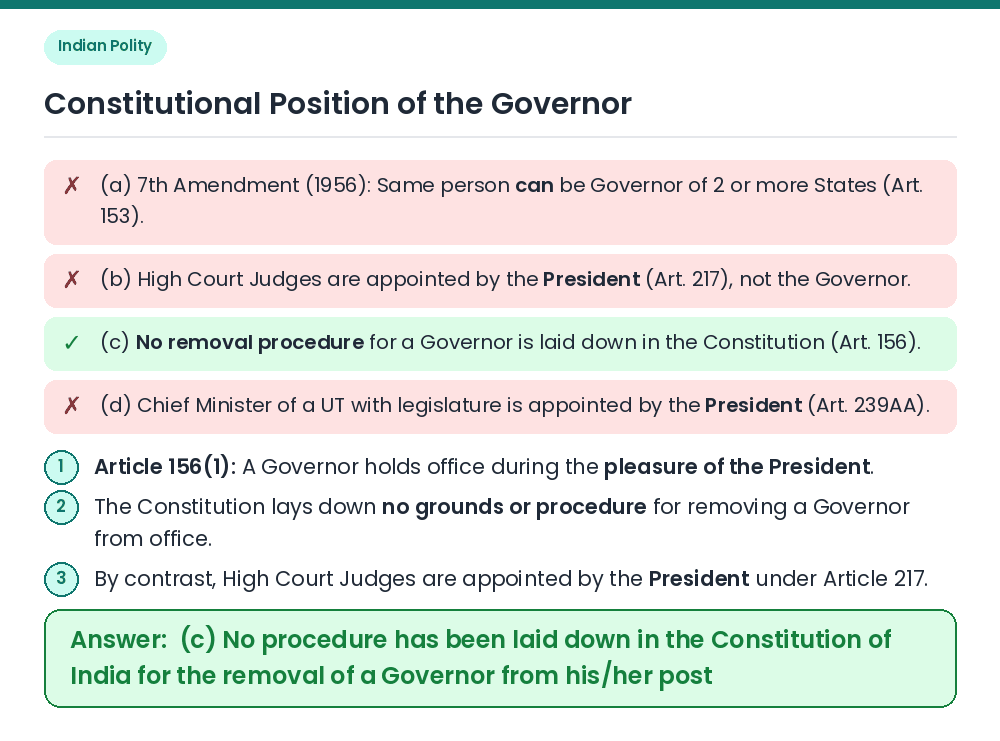
Answer: (C) No procedure has been laid down in the Constitution of India for the removal of a Governor from his/her post
Concept: Articles 153 to 156 of the Constitution deal with the appointment and term of office of the Governor. Step 2 (Evaluate Options (a) & (b)): Under the 7th Constitutional Amendment Act, 1956 (Article 153), the same person can be appointed Governor of two or more States; under Article 217, High Court Judges are appointed by the President, not the Governor. Step 3 (Evaluate Options (c) & (d)): Under Article 156(1), the Governor holds office during the pleasure of the President and no removal procedure is prescribed in the Constitution; in a Union Territory with a legislature, the Chief Minister is appointed by the President (Article 239AA(5) / Section 45 of the UT Act, 1963). Result: Only statement (c) is constitutionally correct. Related Facts: • B.P. Singhal vs Union of India (2010): The Supreme Court held that a Governor cannot be removed arbitrarily on grounds of change of government at the Centre. • Article 155: The Governor of a State is appointed by the President by warrant under his hand and seal. Correct Answer: (c) No procedure has been laid down in the Constitution of India for the removal of a Governor from his/her post