Civil Services Examination · Question 6
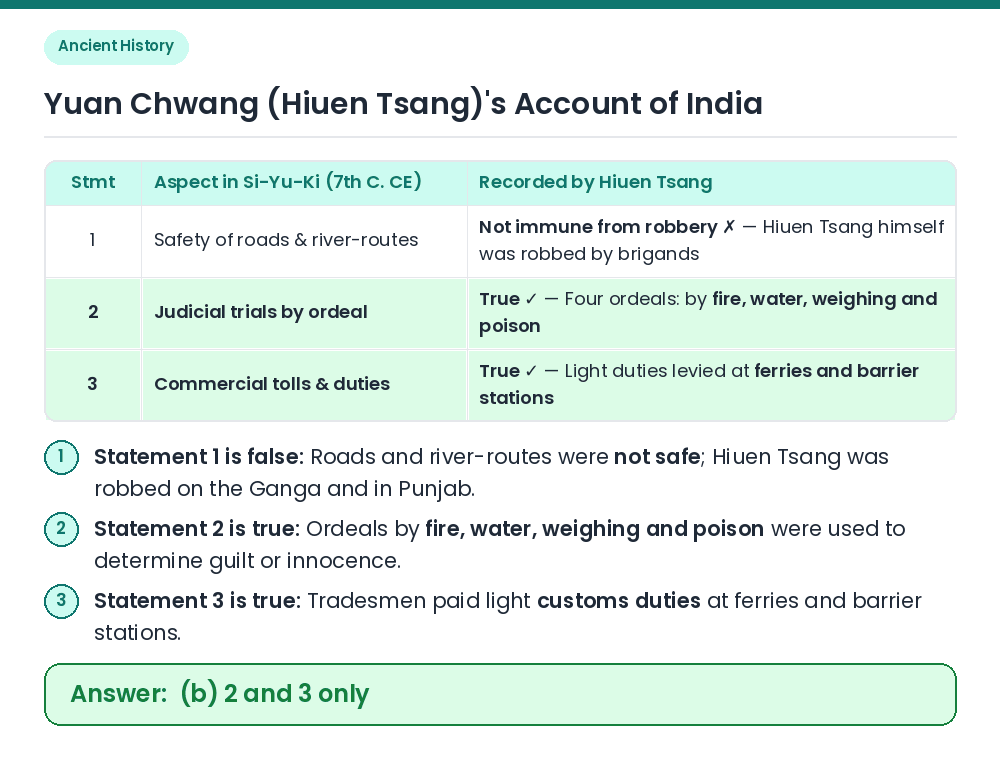
The Chinese traveller Yuan Chwang (Hiuen Tsang) who visited India recorded the general conditions and culture of India at that time. In this context, which of the following statements is/are correct? 1. The roads and river-routes were completely immune from robbery. 2. As regards punishment for offences, ordeals by fire, water and poison were the instruments for determining the innocence or guilt of a person. 3. The tradesmen had to pay duties at ferries and barrier stations. Select the correct answer using the codes given below.
Show answer & explanationShow explanation
Answer: (B) 2 and 3 only
Concept: Hiuen Tsang (Yuan Chwang) visited India during the reign of Emperor Harshavardhana (629–645 CE) and wrote his travelogue Si-Yu-Ki. Check Statement 1: Roads and river-routes were not immune from robbery; Hiuen Tsang himself was captured by river pirates on the Ganga and robbed more than once. Hence Statement 1 is incorrect. Check Statements 2 & 3: Hiuen Tsang explicitly recorded four judicial ordeals — by water, fire, weighing and poison — to establish innocence or guilt (Statement 2 is correct), and noted that tradesmen paid light duties at ferries and barrier stations (Statement 3 is correct). Result: Statements 2 and 3 only are correct. Related Facts: • Reign of Harsha: Hiuen Tsang attended the grand religious assemblies at Kannauj and Prayag (Mahamoksha Parishad). • Nalanda University: Hiuen Tsang studied Buddhist philosophy at Nalanda under the abbot Shilabhadra. Correct Answer: (b) 2 and 3 only