Civil Services Examination · Question 58
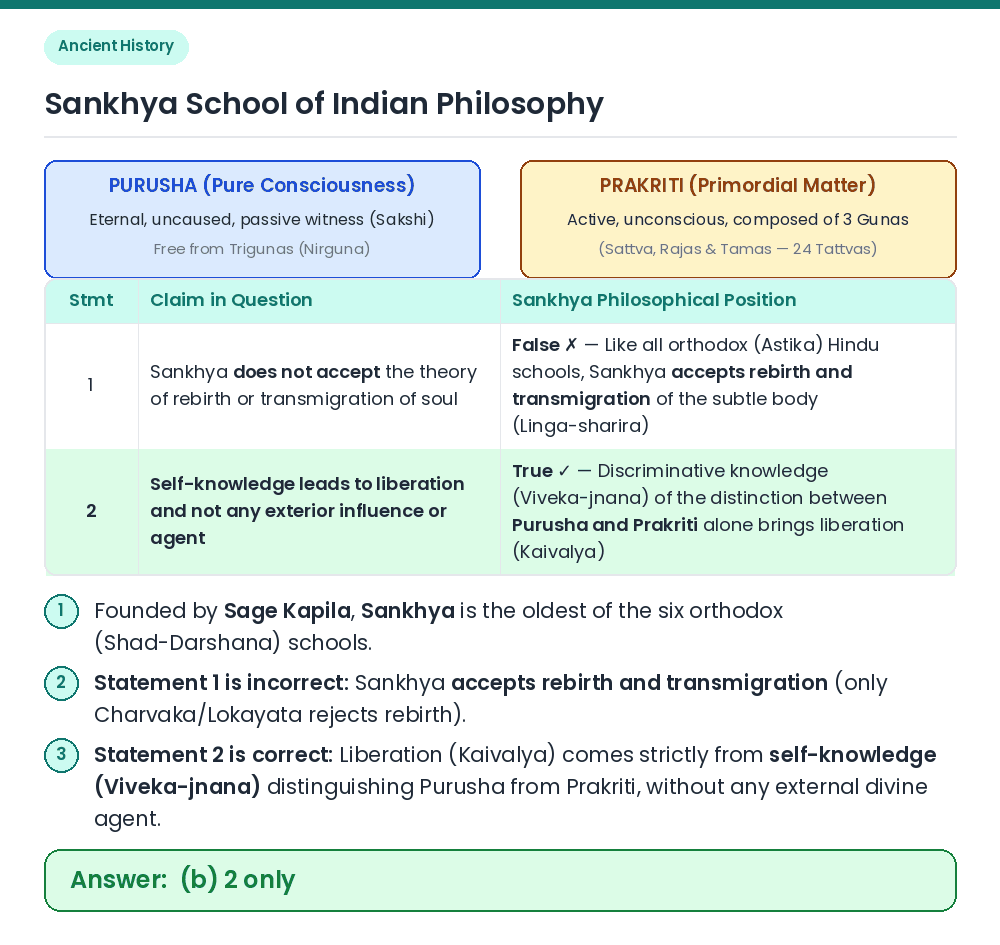
With reference to the history of philosophical thought in India, consider the following statements regarding Sankhya school : 1. Sankhya does not accept the theory of rebirth or transmigration of soul. 2. Sankhya holds that it is the self-knowledge that leads to liberation and not any exterior influence or agent. Which of the statements given above is/are correct?
Show answer & explanationShow explanation
Answer: (B) 2 only
Concept: Propounded by Sage Kapila (and systematized by Ishvarakrishna in the Sankhya Karika), Sankhya is a dualistic orthodox (Astika) school based on two ultimate realities — Purusha (consciousness) and Prakriti (matter). Check Statement 1: Sankhya accepts the doctrine of Karma, rebirth and transmigration of the subtle body (Linga-sharira / Sukshma-sharira) until liberation is attained (only the materialist Charvaka school rejects rebirth). Hence Statement 1 is incorrect. Check Statement 2: Classical Sankhya is non-theistic (Nir-ishvara) and holds that bondage arises from ignorance (Aviveka) identifying Purusha with Prakriti; therefore, true self-knowledge (Viveka-jnana — discriminative knowledge of Purusha's distinctness from Prakriti) alone leads to liberation (Kaivalya), not any exterior influence or agent. Statement 2 is correct. Result: Only Statement 2 is correct. Related Facts: • Satkaryavada: Sankhya's theory of causation holding that the effect pre-exists in its material cause prior to production. • Three Gunas of Prakriti: Sattva (purity/light), Rajas (activity/passion) and Tamas (inertia/darkness). Correct Answer: (b) 2 only