Civil Services Examination · Question 59
In the context of India, which of the following principles is/are implied institutionally in the parliamentary government? 1. Members of the Cabinet are Members of the Parliament. 2. Ministers hold the office till they enjoy confidence in the Parliament. 3. Cabinet is headed by the Head of the State. Select the correct answer using the codes given below.
Show answer & explanationShow explanation
Answer: (A) 1 and 2 only
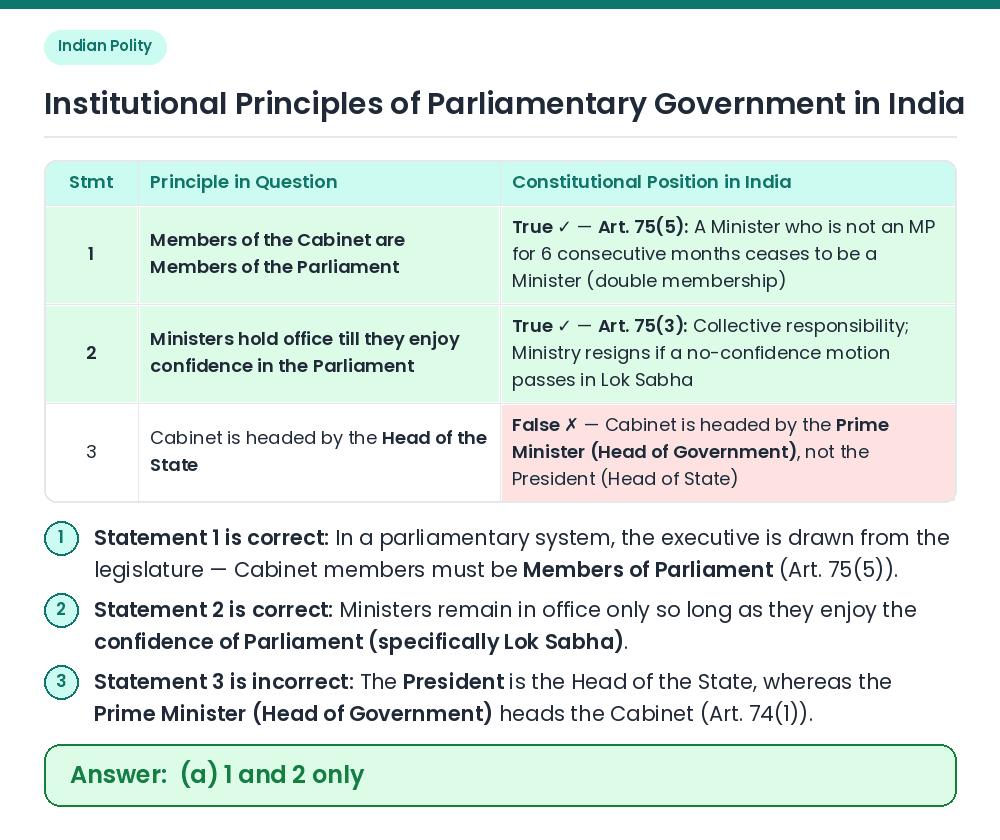
Concept: Core features of the Westminster model of parliamentary government adopted by the Indian Constitution (Articles 74 and 75). Check Statements 1 & 2: In India's parliamentary system, there is close fusion between the legislature and executive — members of the Cabinet are members of Parliament, and under Article 75(5) any non-MP appointed as a Minister must become an MP within 6 months (Statement 1 is correct). Under the principle of collective responsibility (Article 75(3)), the Council of Ministers holds office only so long as it enjoys confidence in Parliament/Lok Sabha (Statement 2 is correct). Check Statement 3: Parliamentary government distinguishes between the nominal executive (Head of the State = President) and the real executive (Head of the Government = Prime Minister). Under Article 74(1), the Council of Ministers/Cabinet is headed by the Prime Minister, not the Head of the State (Statement 3 is incorrect). Result: Statements 1 and 2 only are correct. Related Facts: • Article 352(3): The word 'Cabinet' was inserted into the Constitution (Article 352) by the 44th Constitutional Amendment Act, 1978. • Presidential System Contrast: In the US Presidential system, the President is both Head of State and Head of Government, and Cabinet members cannot be members of Congress. Correct Answer: (a) 1 and 2 only