Civil Services Examination · Question 62
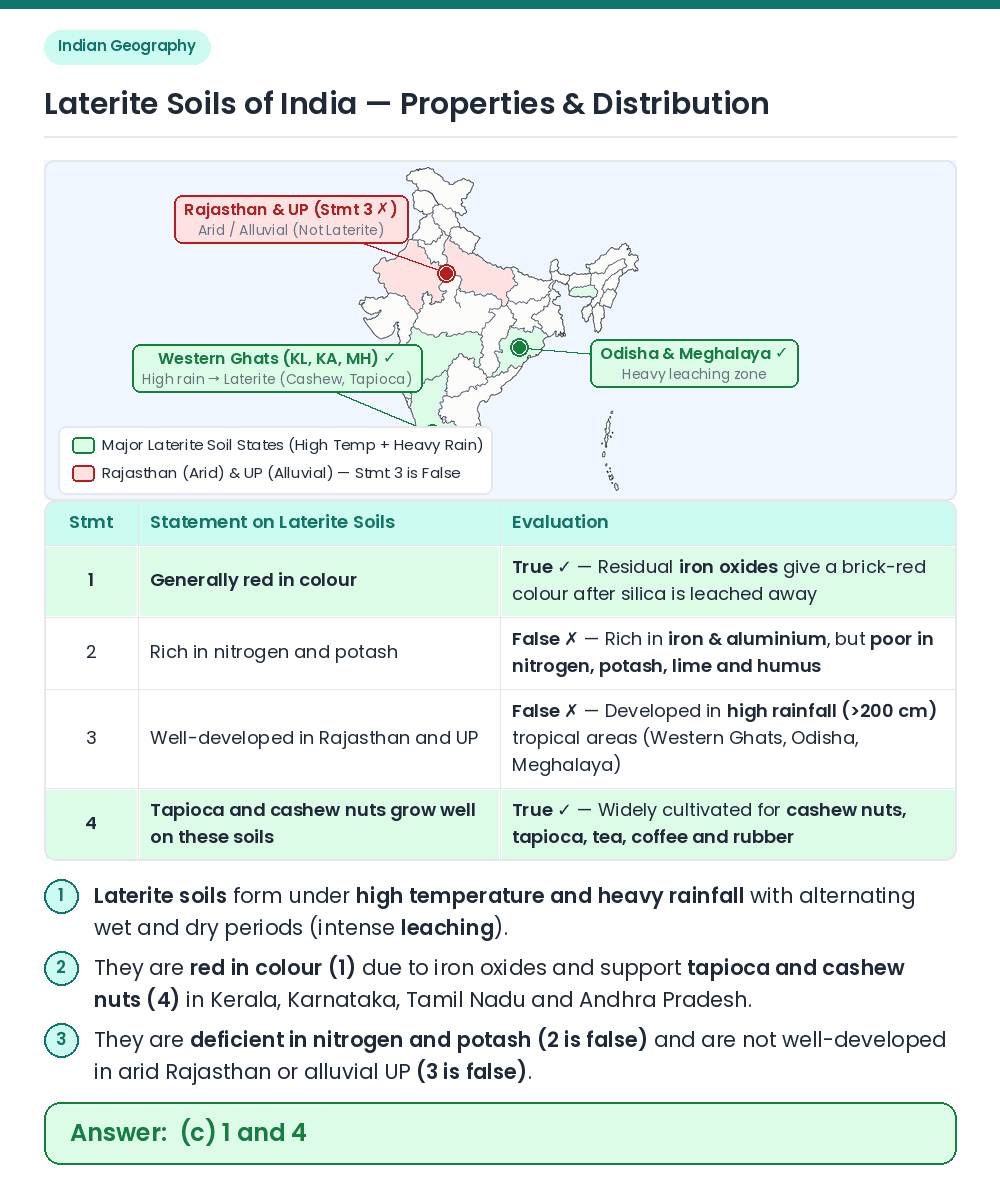
Which of the following statements regarding laterite soils of India are correct? 1. They are generally red in colour. 2. They are rich in nitrogen and potash. 3. They are well-developed in Rajasthan and UP. 4. Tapioca and cashew nuts grow well on these soils. Select the correct answer using the codes given below.
Show answer & explanationShow explanation
Answer: (C) 1 and 4
Concept: Laterite soils (from Latin 'later' meaning brick) develop in tropical regions with high temperature and heavy seasonal rainfall (>200 cm) through intense leaching (desilication). Check Statements 1 & 4: Heavy rain washes away lime and silica, leaving behind iron oxide and aluminium compounds that give laterite soil its characteristic brick-red colour (Statement 1 is correct). With manuring and conservation, red laterite soils in Kerala, Tamil Nadu, Karnataka and Andhra Pradesh are well-suited for tree crops like cashew nuts and tapioca, as well as tea and coffee (Statement 4 is correct). Check Statements 2 & 3: Due to intense leaching and rapid bacterial decomposition of humus, laterite soils are deficient in nitrogen, potash, lime and organic matter (Statement 2 is incorrect). They are well-developed on the summits of the Western Ghats, Eastern Ghats, Odisha and Meghalaya, not in arid Rajasthan or the alluvial plains of UP (Statement 3 is incorrect). Result: Only Statements 1 and 4 are correct. Related Facts: • Building Material: Laterite soil is soft when wet and hardens irreversibly on exposure to air, making it a durable building brick. • Bauxite Ore: High-level laterites are often associated with bauxite (aluminium ore) deposits. Correct Answer: (c) 1 and 4