Civil Services Examination · Question 72
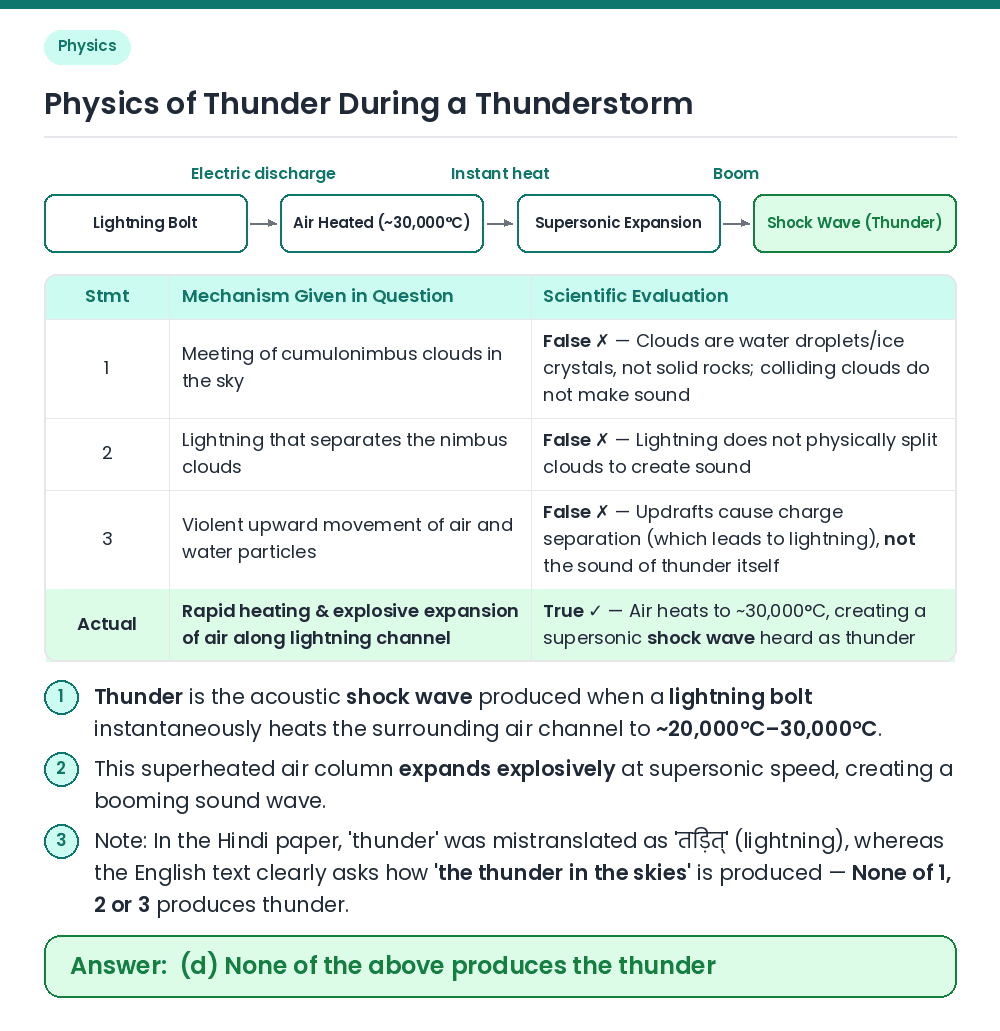
During a thunderstorm, the thunder in the skies is produced by the 1. meeting of cumulonimbus clouds in the sky 2. lightning that separates the nimbus clouds 3. violent upward movement of air and water particles Select the correct answer using the codes given below.
Show answer & explanationShow explanation
Answer: (D) None of the above produces the thunder
Concept: Physical acoustics of thunder (sound) versus electrostatic charge generation in a thunderstorm. How Thunder Is Actually Produced: When a lightning discharge passes through the air, it heats the air along its narrow channel to about 20,000°C–30,000°C (five times hotter than the Sun's surface) in a fraction of a millisecond. This causes a sudden, explosive increase in pressure and supersonic outward expansion of the air, producing an acoustic shock wave heard as thunder. Evaluate 1, 2 & 3: Meeting of cumulonimbus clouds (1) or lightning separating clouds (2) are myths; violent upward movement of air and water particles (3) contributes to electrostatic charge separation inside the cloud (leading to lightning), but does not directly produce the sound wave of thunder. Result: None of the given statements (1, 2 or 3) produces the thunder. Related Facts: • Speed of Light vs Sound: Light travels at ~3 × 10⁸ m/s while sound in air travels at ~343 m/s, which is why lightning is always seen before thunder is heard. • Bilingual Translation Note: In the original UPSC Hindi paper, the English word 'thunder' (गरज / मेघगर्जन) was translated as 'तड़ित्', but the authoritative English version asks about 'the thunder in the skies' and the official key is (d). Correct Answer: (d) None of the above produces the thunder