Civil Services Examination · Question 74
Consider the following liquid assets : 1. Demand deposits with the banks 2. Time deposits with the banks 3. Savings deposits with the banks 4. Currency The correct sequence of these assets in the decreasing order of liquidity is
Show answer & explanationShow explanation
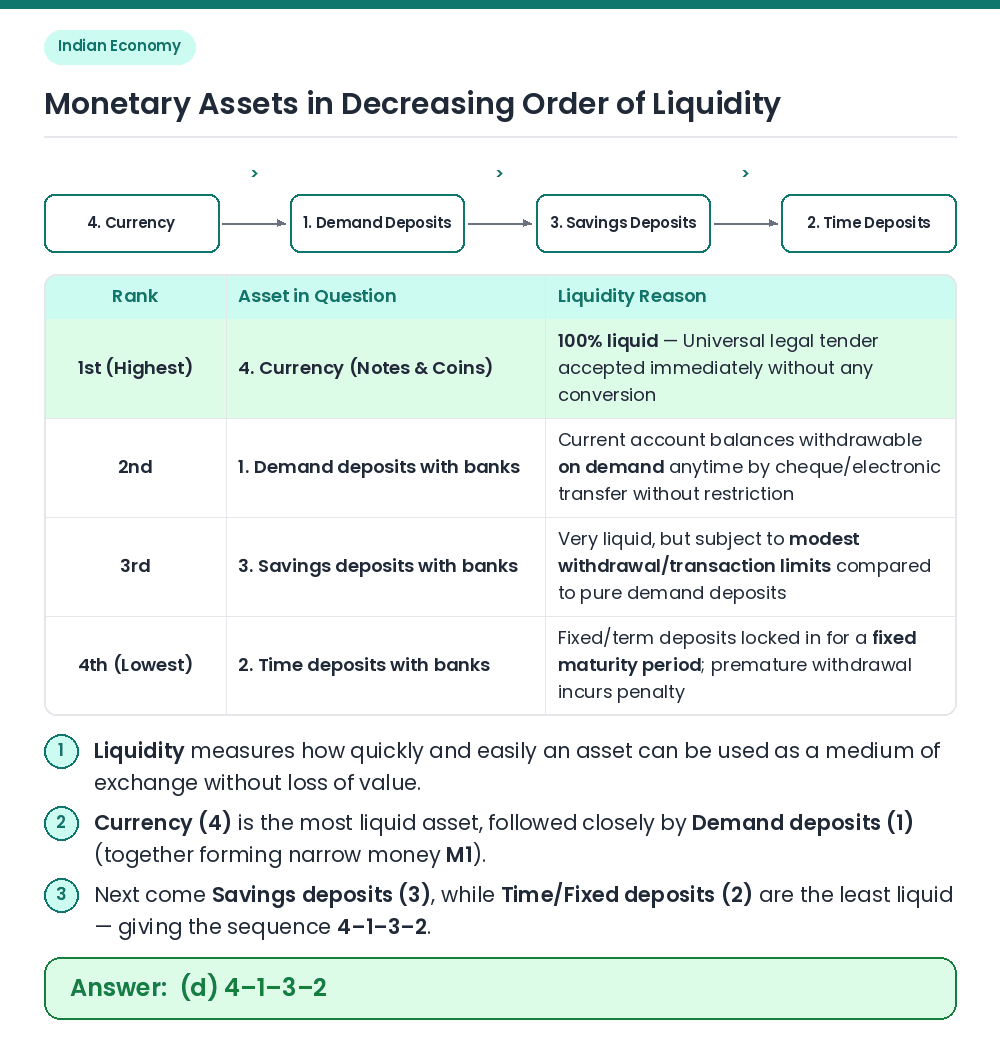
Answer: (D) 4–1–3–2
Concept: Liquidity of an asset refers to the ease and speed with which it can be converted into cash or used directly for making payments without loss of value. Compare Currency & Demand Deposits — 4 & 1: Currency (notes and coins held by the public — 4) is the most liquid asset as it is ready legal tender. Next comes Demand deposits with banks (current account deposits payable immediately on demand via cheque — 1). Compare Savings & Time Deposits — 3 & 2: Savings deposits with banks (3) come next as they combine features of demand and time deposits with minor withdrawal ceilings, whereas Time deposits (Fixed Deposits — 2) have a fixed maturity lock-in period and are the least liquid among the four. Result: The decreasing order of liquidity is 4–1–3–2. Related Facts: • Narrow Money (M1) vs Broad Money (M3): M1 = Currency with public + Demand deposits + Other deposits with RBI (most liquid); M3 = M1 + Time deposits with banks (broad money). • Liquidity vs Interest Return: As liquidity decreases from Currency (0% interest) to Time Deposits, the interest rate earned increases. Correct Answer: (d) 4–1–3–2