Civil Services Examination · Question 79
In the context of cultural history of India, a pose in dance and dramatics called 'Tribhanga' has been a favourite of Indian artists from ancient times till today. Which one of the following statements best describes this pose?
Show answer & explanationShow explanation
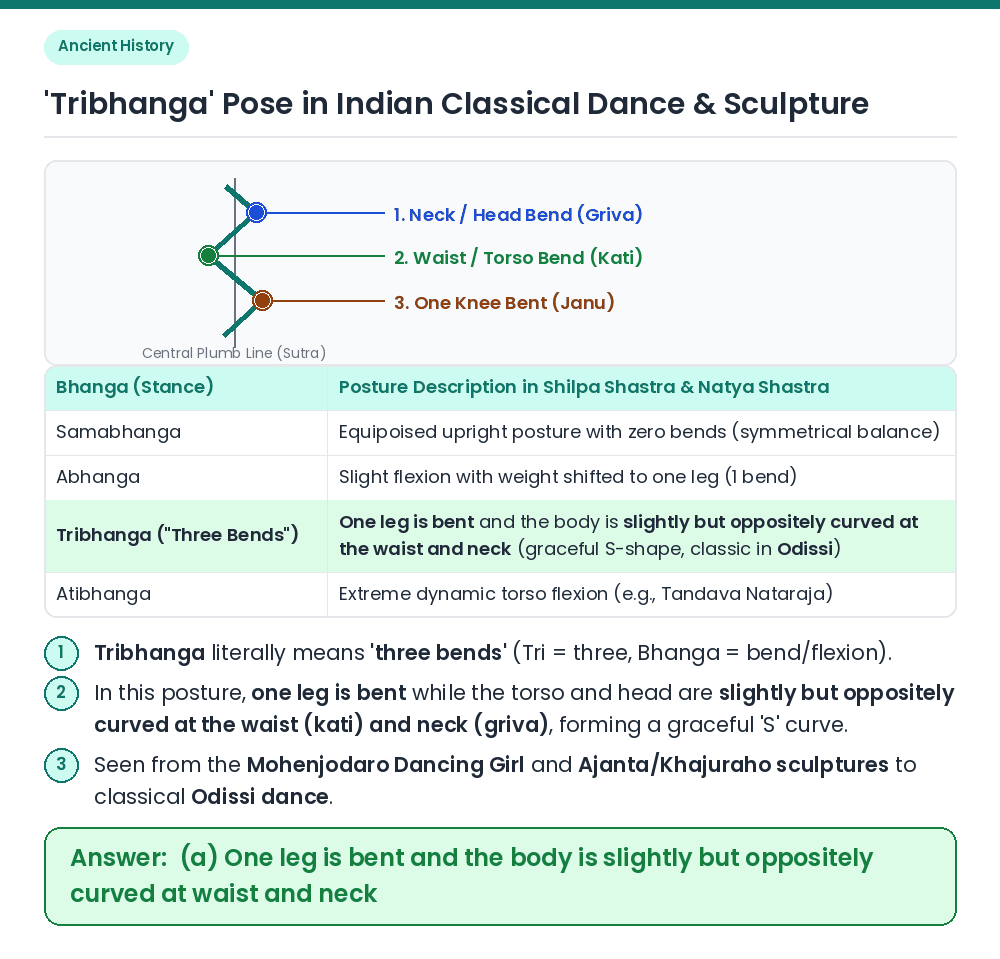
Answer: (A) One leg is bent and the body is slightly but oppositely curved at waist and neck
Concept: In Indian iconography (Shilpa Shastra) and classical dance (Natya Shastra / Abhinaya Darpana), 'Tribhanga' literally translates to 'three bends' (Tri = three, Bhanga = bend). Anatomy of the Pose: The body weight is shifted with one leg bent at the knee, while the upper body deflects in opposite directions at the waist (hips/kati) and the neck (shoulders/griva), creating a graceful serpentine 'S'-shaped posture. Historical & Classical Continuity: This pose appears in the bronze 'Dancing Girl' of Mohenjodaro, Yakshi figures at Sanchi, Ajanta Bodhisattva murals, Khajuraho/Konark sculptures, Lord Krishna playing the flute, and forms the foundational stance of Odissi dance. Result: Option (a) accurately describes the Tribhanga pose. Related Facts: • Odissi Dance Stances: Odissi uses two signature postures — Chowk (masculine square stance) and Tribhanga (feminine three-bend stance). • Other Bhangas: Samabhanga (straight, no bend), Abhanga (single slight bend) and Atibhanga (great/extreme bend). Correct Answer: (a) One leg is bent and the body is slightly but oppositely curved at waist and neck