Civil Services Examination · Question 65
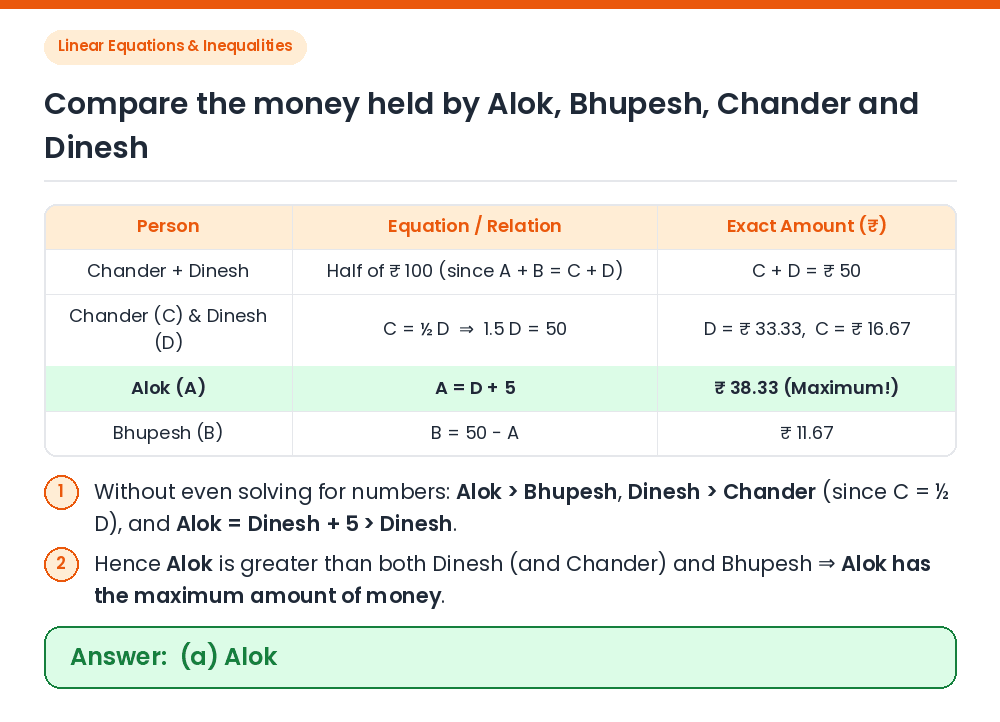
Four persons, Alok, Bhupesh, Chander and Dinesh have a total of ₹ 100 among themselves. Alok and Bhupesh between them have as much money as Chander and Dinesh between them, but Alok has more money than Bhupesh; and Chander has only half the money that Dinesh has. Alok has in fact ₹ 5 more than Dinesh has. Who has the maximum amount of money?
Show answer & explanationShow explanation
Answer: (A) Alok
Given / Concept: Four persons A, B, C, D have ₹ 100 in total, with A + B = C + D = ₹ 50. Compare the four amounts using inequalities: ⇒ Alok has more money than Bhupesh: A > B. ⇒ Chander has half of Dinesh's money: D > C. ⇒ Alok has ₹ 5 more than Dinesh: A = D + 5 ⇒ A > D > C. Exact values check: C + D = 50 and C = D/2 ⇒ D = ₹ 33.33, C = ₹ 16.67, A = ₹ 38.33, B = ₹ 11.67. Result: Alok has the maximum amount of money. Shortcut: A > B and A > D > C immediately makes Alok the highest without any calculation. Correct Answer: (a) Alok