Civil Services Examination · Question 42
Passage – 2: The Global Financial Stability Report finds that the share of portfolio investments from advanced economies in the total debt and equity investments in emerging economies has doubled in the past decade to 12 percent. The phenomenon has implications for Indian policy makers as foreign portfolio investments in the debt and equity markets have been on the rise. The phenomenon is also flagged as a threat that could compromise global financial stability in a chain reaction, in the event of United States Federal Reserve's imminent reversal of its "Quantitative Easing" policy. Which among the following is the most rational and critical inference that can be made from the above passage?
Show answer & explanationShow explanation
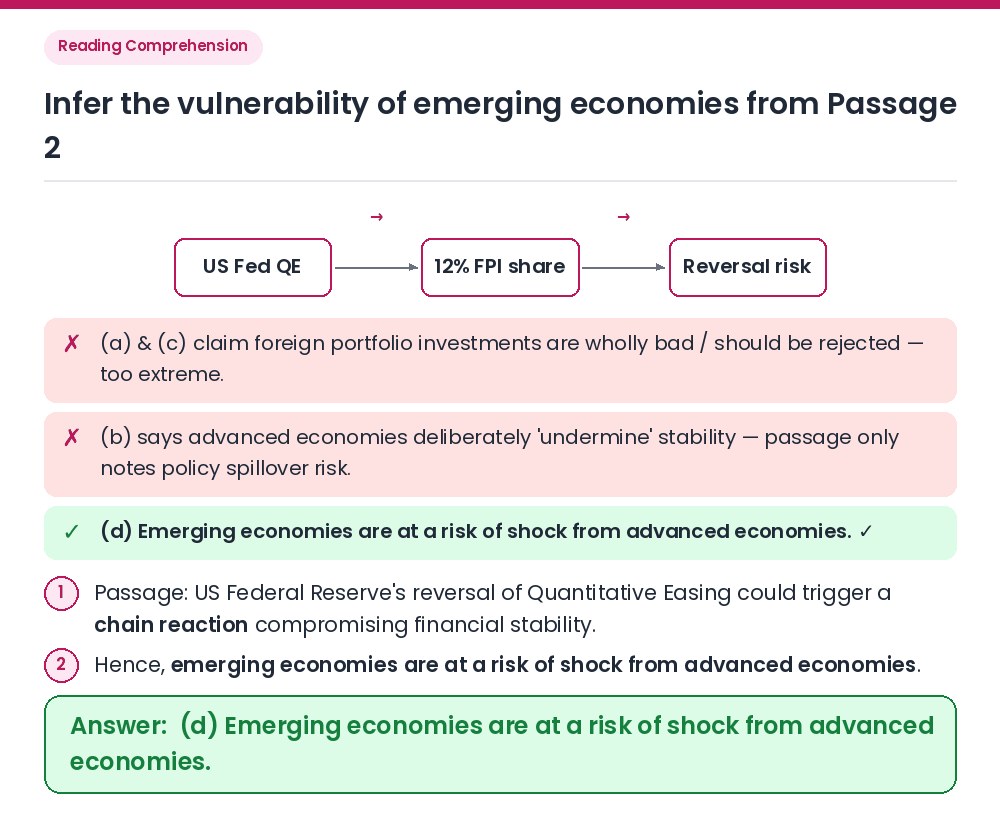
Answer: (D) Emerging economies are at a risk of shock from advanced economies.
Given / Concept: Portfolio investments from advanced economies into emerging markets have doubled to 12%, creating a threat of a chain reaction if the US Fed reverses its Quantitative Easing policy. Step 2 (Evaluate options (a), (b), (c)): Calling FPI inherently bad (a), accusing advanced economies of undermining stability (b), or advising India to stop accepting FPI (c) are extreme and unwarranted. Step 3 (Verify inference (d)): Because a policy reversal in an advanced economy (US Fed) can trigger a chain reaction in emerging markets, emerging economies face a risk of shock from advanced economies. Result: Option (d) is the most rational inference. Correct Answer: (d) Emerging economies are at a risk of shock from advanced economies.