Civil Services Examination · Question 43
Passage – 3: Open defecation is disastrous when practised in very densely populated areas, where it is impossible to keep away human faeces from crops, wells, food and children's hands. Groundwater is also contaminated by open defecation. Many ingested germs and worms spread diseases. They prevent the body from absorbing calories and nutrients. Nearly one-half of India's children remain malnourished. Lakhs of them die from preventable conditions. Diarrhoea leaves Indians' bodies smaller on average than those of people in some poorer countries where people eat fewer calories. Underweight mothers produce stunted babies prone to sickness who may fail to develop their full cognitive potential. The germs released into environment harm rich and poor alike, even those who use latrines. Which among the following is the most critical inference that can be made from the above passage?
Show answer & explanationShow explanation
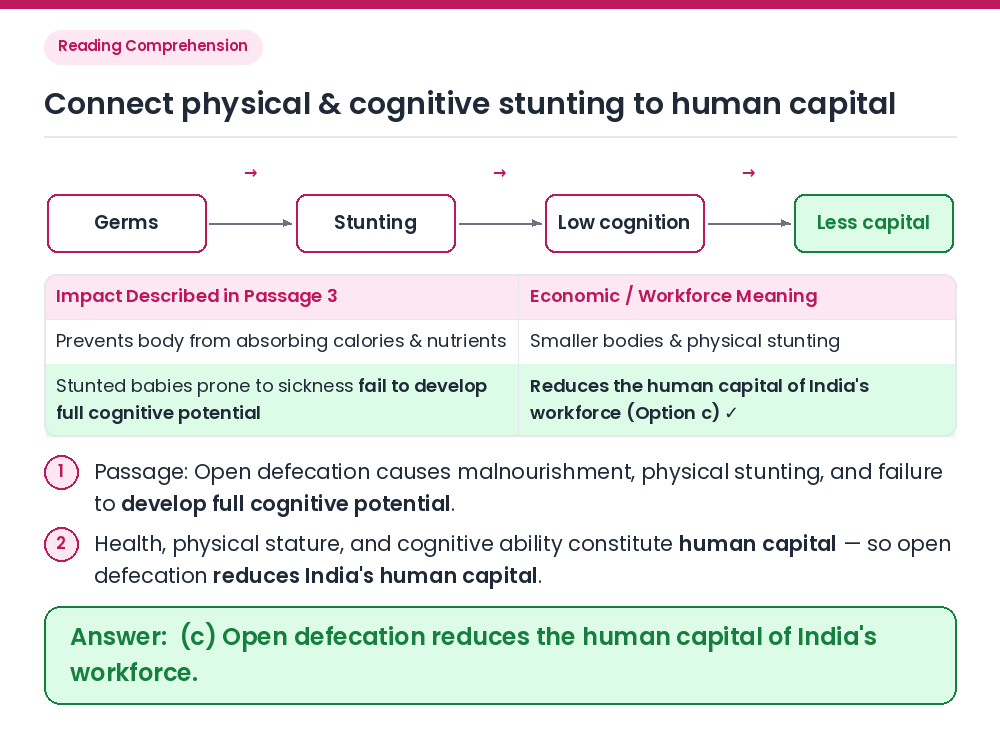
Answer: (C) Open defecation reduces the human capital of India's workforce.
Given / Concept: The passage explains how open defecation causes malnourishment, smaller physical bodies, sickness, and failure to develop full cognitive potential in India's children. Connect to human capital: Physical health, stamina, and cognitive potential of citizens growing into workers are the core components of a nation's human capital. Eliminate other options: (a) government resources are not mentioned; (b) 'most important' and (d) 'all developing countries' are unsupported generalizations. Result: Open defecation reduces the human capital of India's workforce. Correct Answer: (c) Open defecation reduces the human capital of India's workforce.