Civil Services Examination · Question 47
Passage – 6: Governments may have to take steps which would otherwise be an infringement on the Fundamental Rights of individuals, such as acquiring a person's land against his will, or refusing permission for putting up a building, but the larger public interest for which these are done must be authorized by the people (Parliament). Discretionary powers to the administration can be done away with. It is becoming more and more difficult to keep this power within limits as the government has many number of tasks to perform. Where discretion has to be used, there must be rules and safeguards to prevent misuse of that power. Systems have to be devised which minimise, if not prevent, the abuse of discretionary power. Government work must be conducted within a framework of recognised rules and principles, and decisions should be similar and predictable. Which among the following is the most logical assumption that can be made from the above passage?
Show answer & explanationShow explanation
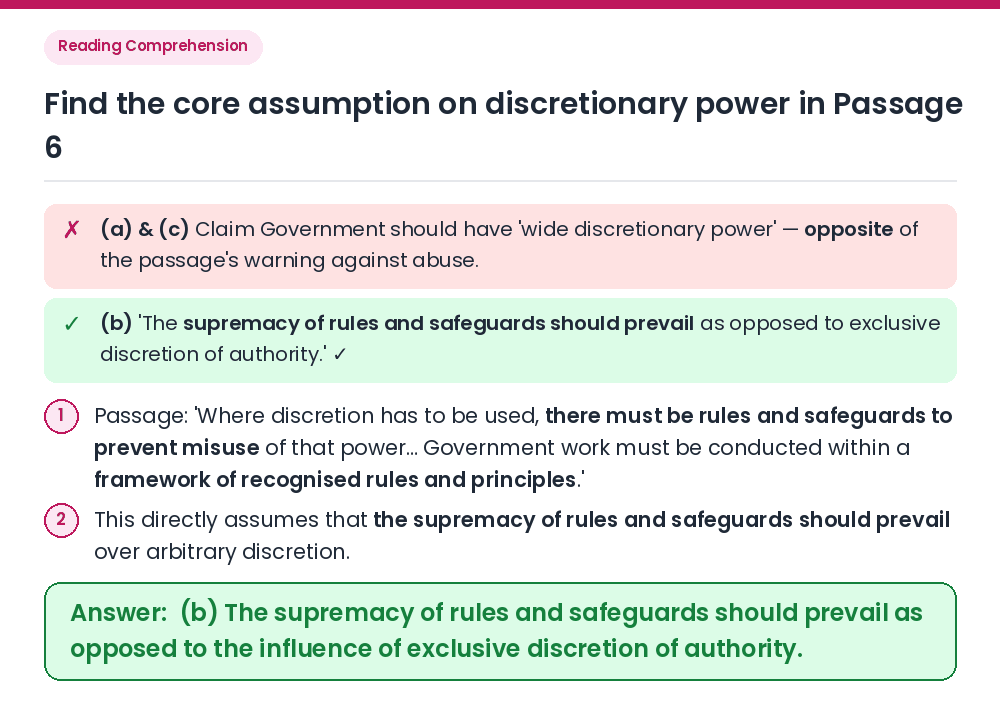
Answer: (B) The supremacy of rules and safeguards should prevail as opposed to the influence of exclusive discretion of authority.
Given / Concept: The passage argues that administrative discretion should be done away with or strictly bounded by rules, safeguards, and recognized principles so decisions are predictable. Step 2 (Eliminate (a) and (c)): Both (a) and (c) advocate wider discretionary power for the government, which is the exact opposite of the passage. Step 3 (Verify (b)): Insisting that government work be conducted within a framework of recognized rules and safeguards assumes that the supremacy of rules and safeguards must prevail over exclusive discretion. Result: Option (b) is the most logical assumption. Correct Answer: (b) The supremacy of rules and safeguards should prevail as opposed to the influence of exclusive discretion of authority.