Civil Services Examination · Question 27
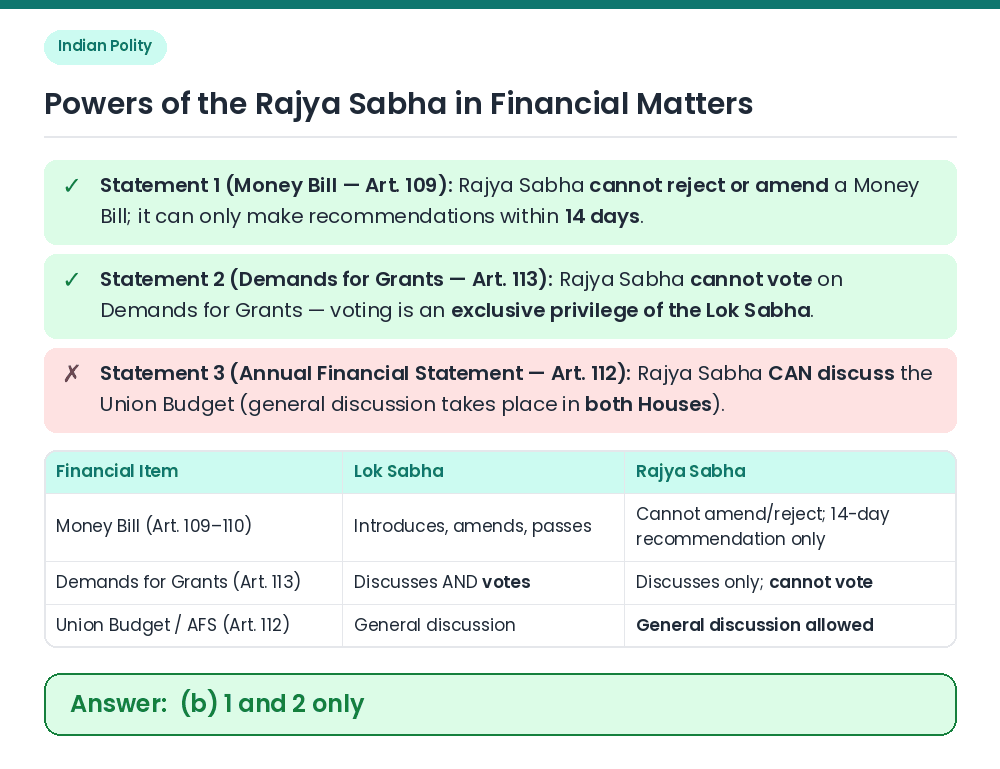
Consider the following statements : 1. The Rajya Sabha has no power either to reject or to amend a Money Bill. 2. The Rajya Sabha cannot vote on the Demands for Grants. 3. The Rajya Sabha cannot discuss the Annual Financial Statement. Which of the statements given above is/are correct?
Show answer & explanationShow explanation
Answer: (B) 1 and 2 only
Concept: Articles 109 to 113 of the Indian Constitution define the asymmetric powers of the Lok Sabha and the Rajya Sabha over Money Bills and the Union Budget. Evaluate Statements 1 and 2: ⇒ Under Article 109, the Rajya Sabha cannot reject or amend a Money Bill and must return it within 14 days with or without recommendations (Statement 1 is correct). Under Article 113(2), voting on Demands for Grants is the exclusive power of the Lok Sabha (Statement 2 is correct). Evaluate Statement 3: ⇒ Under Article 112, the Annual Financial Statement (Union Budget) is laid before both Houses of Parliament, and the Rajya Sabha holds a full general discussion on it — Statement 3 is incorrect. Conclusion: Statements 1 and 2 only are correct. • Related Facts: The Speaker of the Lok Sabha has the final authority to certify whether a Bill is a Money Bill under Article 110(3). • No Joint Sitting: There is no provision for a joint sitting (Article 108) in the case of a Money Bill. Correct Answer: (b) 1 and 2 only