Civil Services Examination · Question 28
The Government of India Act of 1919 clearly defined
Show answer & explanationShow explanation
Answer: (B) the jurisdiction of the central and provincial governments
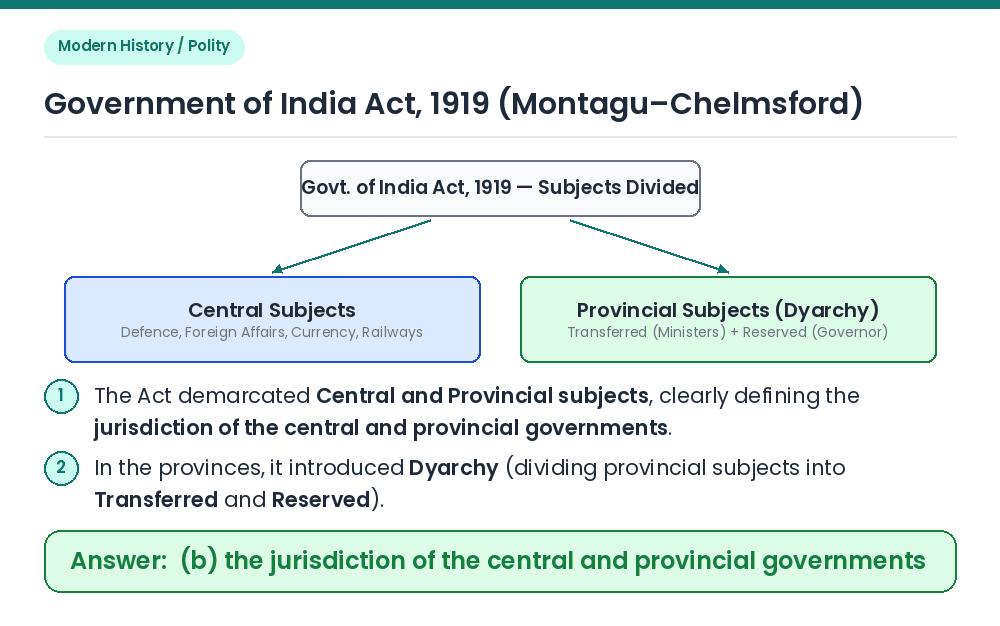
Concept: The Government of India Act, 1919 (also known as the Montagu–Chelmsford Reforms) relaxed central control over the provinces by demarcating and separating the central and provincial subjects. Division of Jurisdiction: ⇒ The central and provincial legislatures were authorized to make laws on their respective lists of subjects, thereby clearly defining the jurisdiction of the central and provincial governments. Additional Features: ⇒ It further divided provincial subjects into 'Transferred' (administered by Governor with Ministers responsible to Legislative Council) and 'Reserved' (administered by Governor with Executive Council) — known as Dyarchy. Conclusion: The Act of 1919 clearly defined the jurisdiction of the central and provincial governments. • Related Facts: The Act of 1919 also introduced bicameralism and direct elections at the Centre for the first time. • Separation of Judiciary and Executive: Enshrined later in Article 50 (DPSP) of the Constitution of India. Correct Answer: (b) the jurisdiction of the central and provincial governments