Civil Services Examination · Question 6
Read the following passage and answer the item that follows. Your answer to this item should be based on the passage only. Passage: In general, religious traditions stress our duty to god, or to some universal ethical principle. Our duties to one another derive from these. The religious concept of rights is primarily derived from our relationship to this divinity or principle and the implication it has on our other relationships. This correspondence between rights and duties is critical to any further understanding of justice. But, for justice to be practiced; virtue, rights and duties cannot remain formal abstractions. They must be grounded in a community (common unity) bound together by a sense of common union (communion). Even as a personal virtue, this solidarity is essential to the practice and understanding of justice. Which one of the following is the crux of this passage?
Show answer & explanationShow explanation
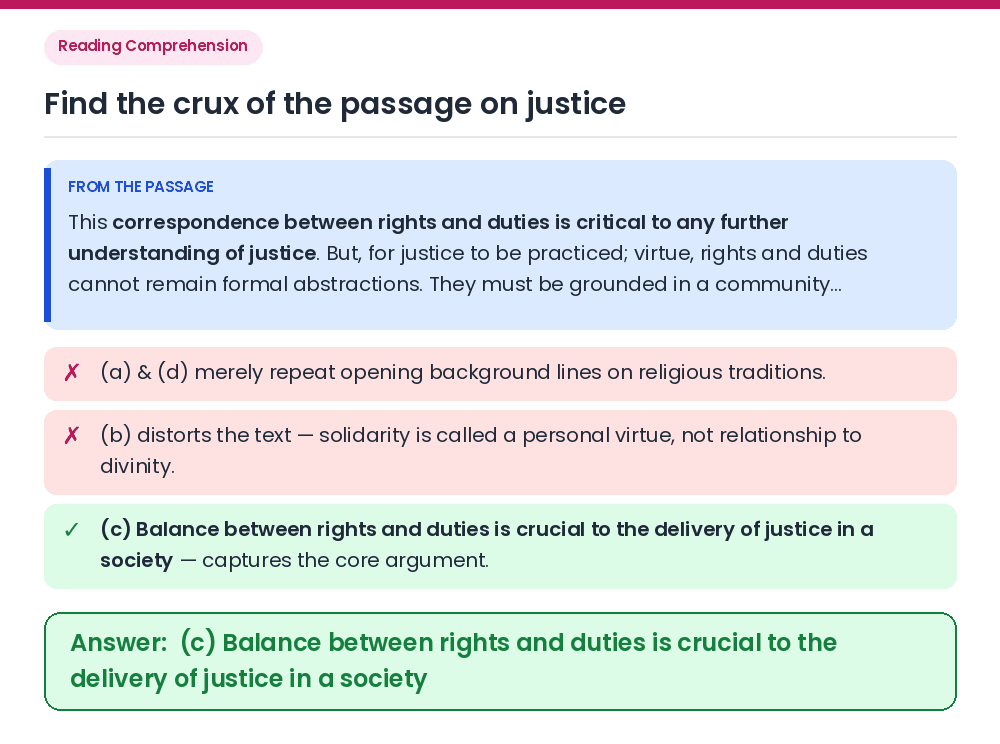
Answer: (C) Balance between rights and duties is crucial to the delivery of justice in a society
Concept: The crux is the central thesis toward which the passage builds, rather than introductory details. Analyze Passage Flow: After introducing how duties and rights arise, the author states: 'This correspondence between rights and duties is critical to any further understanding of justice' and must be grounded in a community. Evaluate Options: Options (a) and (d) only restate introductory sentences, while (b) misstates what the passage calls a personal virtue (solidarity). Result: Option (c) captures the central thesis linking the balance of rights and duties to justice in society. Correct Answer: (c) Balance between rights and duties is crucial to the delivery of justice in a society