Civil Services Examination · Question 6
Read the following passage and answer the item that follows. Your answer to this item should be based on the passage only. Passage—6 By 2020, when the global economy is expected to run short of 56 million young people, India, with its youth surplus of 47 million, could fill the gap. It is in this context that labour reforms are often cited as the way to unlock double-digit growth in India. In 2014, India's labour force was estimated to be about 40 per cent of the population, but 93 per cent of this force was in unorganized sector. Over the last decade, the compound annual growth rate (CAGR) of employment has slowed to 0.5 per cent, with about 14 million jobs created during last year when the labour force increased by about 15 million. Which of the following is the most rational inference from the above passage?
Show answer & explanationShow explanation
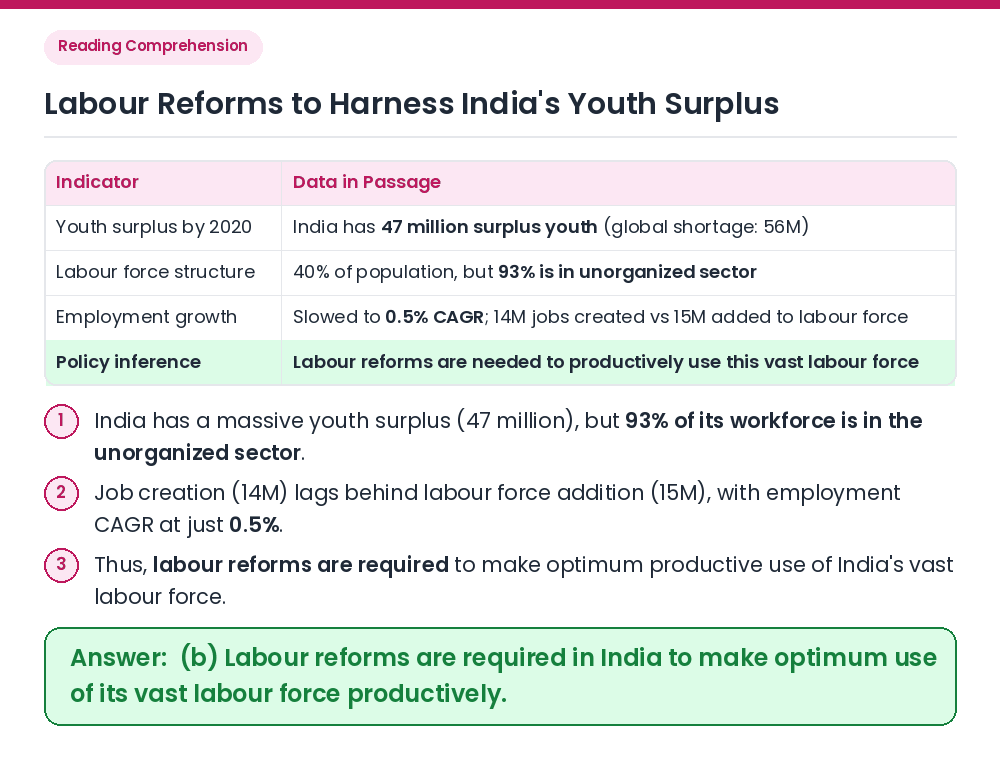
Answer: (B) Labour reforms are required in India to make optimum use of its vast labour force productively.
Concept: The passage highlights India's 47 million youth surplus alongside structural bottlenecks (93% in the unorganized sector, 0.5% employment CAGR). Passage Analysis: Labour reforms are cited in this context because without reforming the labour market, India cannot productively absorb its growing workforce. Elimination: (a) Population control is not suggested; (c) double-digit growth is conditional on reforms, not guaranteed; (d) 'skilled' youth supply is not stated. Result: Labour reforms are required in India to make optimum use of its vast labour force productively. Correct Answer: (b) Labour reforms are required in India to make optimum use of its vast labour force productively.