Civil Services Examination · Question 65
Read the following passage and answer the item that follows. Your answer to this item should be based on the passage only. Passage—5 Over the last decade, Indian agriculture has become more robust with record production of food grains and oilseeds. Increased procurement, consequently, has added huge stocks of food grains in the granaries. India is one of the world's top producers of rice, wheat, milk, fruits and vegetables. India is still home to a quarter of all undernourished people in the world. On an average, almost half of the total expenditure of nearly half of the households is on food. Which among the following is the most logical corollary to the above passage?
Show answer & explanationShow explanation
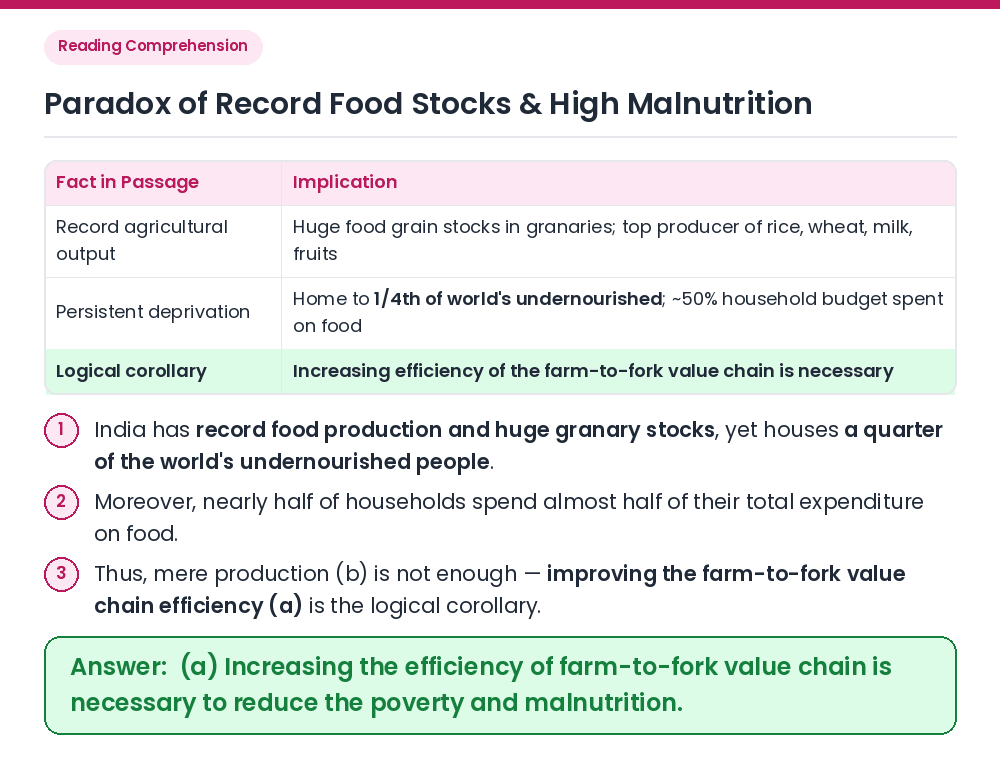
Answer: (A) Increasing the efficiency of farm-to-fork value chain is necessary to reduce the poverty and malnutrition.
Concept: The passage highlights a stark paradox: record farm production and overflowing granaries coexist with massive undernutrition and high food expenditure for households. Passage Analysis: Since high production and procurement alone have not solved malnutrition or high consumer food costs, the bottleneck lies between the farm/granary and the consumer's plate (the farm-to-fork value chain). Elimination: (b) is refuted by the passage itself (high production hasn't automatically eliminated malnutrition); (c) confuses total production with productivity; (d) claims welfare funds alone 'will ultimately eliminate' poverty. Result: Increasing the efficiency of the farm-to-fork value chain is necessary to reduce poverty and malnutrition. Correct Answer: (a) Increasing the efficiency of farm-to-fork value chain is necessary to reduce the poverty and malnutrition.