Civil Services Examination · Question 14
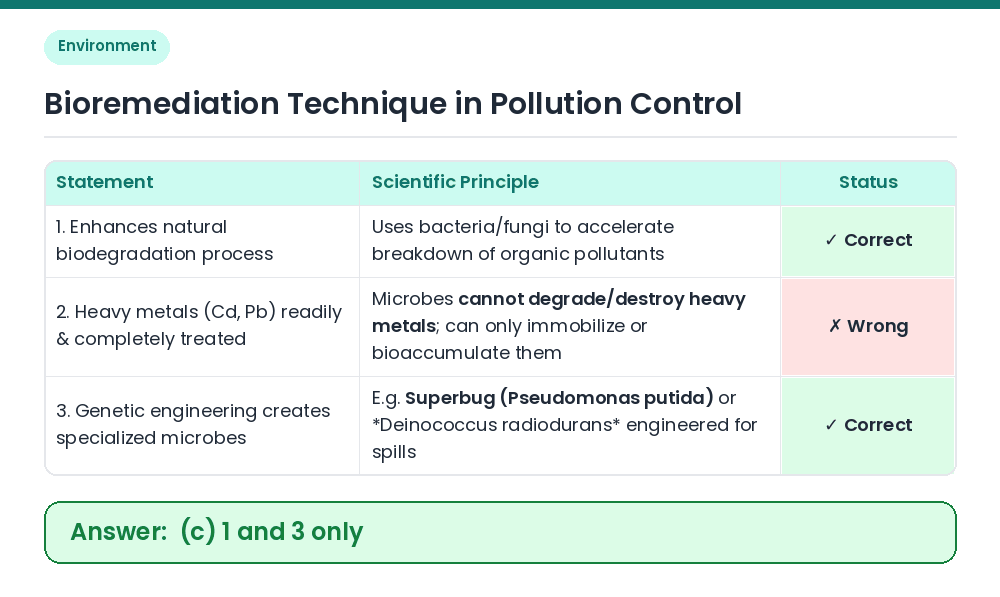
In the context of solving pollution problems, what is/are the advantage/advantages of bioremediation technique ? 1. It is a technique for cleaning up pollution by enhancing the same biodegradation process that occurs in nature. 2. Any contaminant with heavy metals such as cadmium and lead can be readily and completely treated by bioremediation using microorganisms. 3. Genetic engineering can be used to create microorganisms specifically designed for bioremediation. Select the correct answer using the code given below :
Show answer & explanationShow explanation
Answer: (C) 1 and 3 only
Concept: Bioremediation uses living organisms (primarily bacteria, fungi and plants) to degrade or detoxify environmental contaminants into less toxic forms. Evaluate Statement 1: It works by stimulating or enhancing natural biodegradation processes (e.g. adding nutrients or oxygen to indigenous microbes) ⇒ Statement 1 is correct. Evaluate Statement 2: Heavy metals like cadmium and lead are elemental and non-biodegradable; microorganisms cannot readily and completely degrade them ⇒ Statement 2 is incorrect. Evaluate Statement 3: Genetic engineering is used to create genetically modified microorganisms (such as Dr. Ananda Mohan Chakrabarty's oil-eating Pseudomonas putida) specifically designed for bioremediation ⇒ Statement 3 is correct. Result: Statements 1 and 3 are correct. Related Facts: • In-situ vs Ex-situ: Bioventing, biosparging and bioaugmentation are in-situ techniques; landfarming and biopiles are ex-situ techniques. • Oilzapper: Developed by TERI, a consortium of five bacterial strains used to degrade crude oil spills. Correct Answer: (c) 1 and 3 only