Civil Services Examination · Question 15
The Trade Disputes Act of 1929 provided for (a) the participation of workers in the management of industries. (b) arbitrary powers to the management to quell industrial disputes. (c) an intervention by the British Court in the event of a trade dispute. (d) a system of tribunals and a ban on strikes.
Show answer & explanationShow explanation
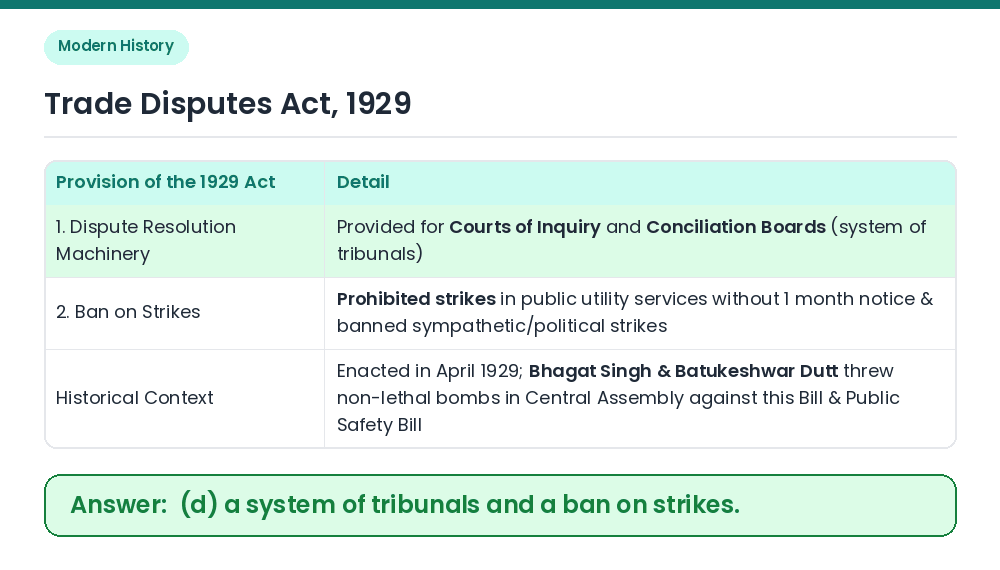
Answer: (D) a system of tribunals and a ban on strikes.
Concept: The Trade Disputes Act, 1929 was enacted by the British Indian Government during a wave of militant labour strikes in 1928–29. Identify key provisions: It established ad-hoc Courts of Inquiry and Conciliation Boards (a system of tribunals) for settling industrial disputes and banned strikes in public utility services (like railways, post, water and electricity) without one month's prior notice, as well as political/sympathetic strikes. Result: The Act provided for a system of tribunals and a ban on strikes. Related Facts: • Assembly Bomb Incident (8 April 1929): Bhagat Singh and Batukeshwar Dutt threw bombs in the Central Legislative Assembly to protest against the Trade Disputes Bill and the Public Safety Bill. • Earlier Labour Law: The Trade Unions Act, 1926 gave legal recognition to registered trade unions. Correct Answer: (d) a system of tribunals and a ban on strikes.