Civil Services Examination · Question 92
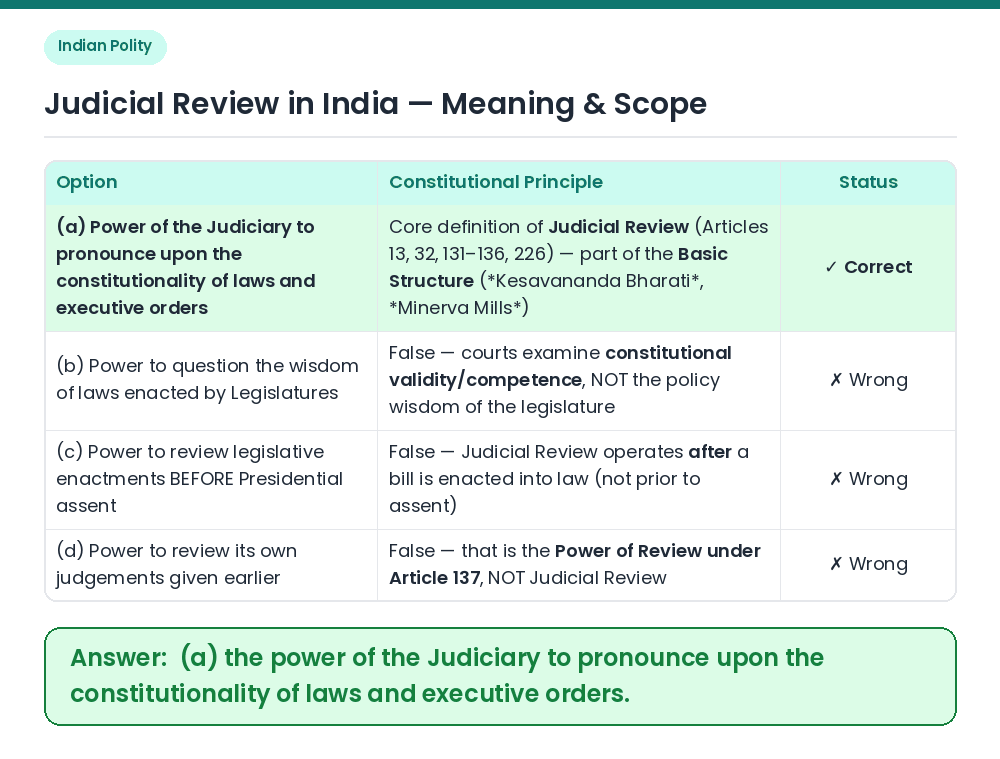
In India, Judicial Review implies (a) the power of the Judiciary to pronounce upon the constitutionality of laws and executive orders. (b) the power of the Judiciary to question the wisdom of the laws enacted by the Legislatures. (c) the power of the Judiciary to review all the legislative enactments before they are assented to by the President. (d) the power of the Judiciary to review its own judgements given earlier in similar or different cases.
Show answer & explanationShow explanation
Answer: (A) the power of the Judiciary to pronounce upon the constitutionality of laws and executive orders.
Concept: Judicial Review is the power of the Supreme Court and High Courts to examine the constitutionality of legislative enactments and executive orders of both the Central and State governments. Distinguish from other options: If a law or executive order violates the Constitution (ultra vires), the judiciary declares it null and void (Option a ✓); courts do not question legislative policy wisdom (b ✗), do not review bills before Presidential assent (c ✗), and reviewing their own earlier judgments is 'Review Jurisdiction' under Article 137, not Judicial Review (d ✗). Result: Option (a) defines Judicial Review in India. Related Facts: • Constitutional Provisions: Expressly grounded in Articles 13, 32, 131–136, 143, 226, and 246 of the Constitution, and declared part of the 'Basic Structure' in Indira Nehru Gandhi (1975) and Minerva Mills (1980). Correct Answer: (a) the power of the Judiciary to pronounce upon the constitutionality of laws and executive orders.