Civil Services Examination · Question 26
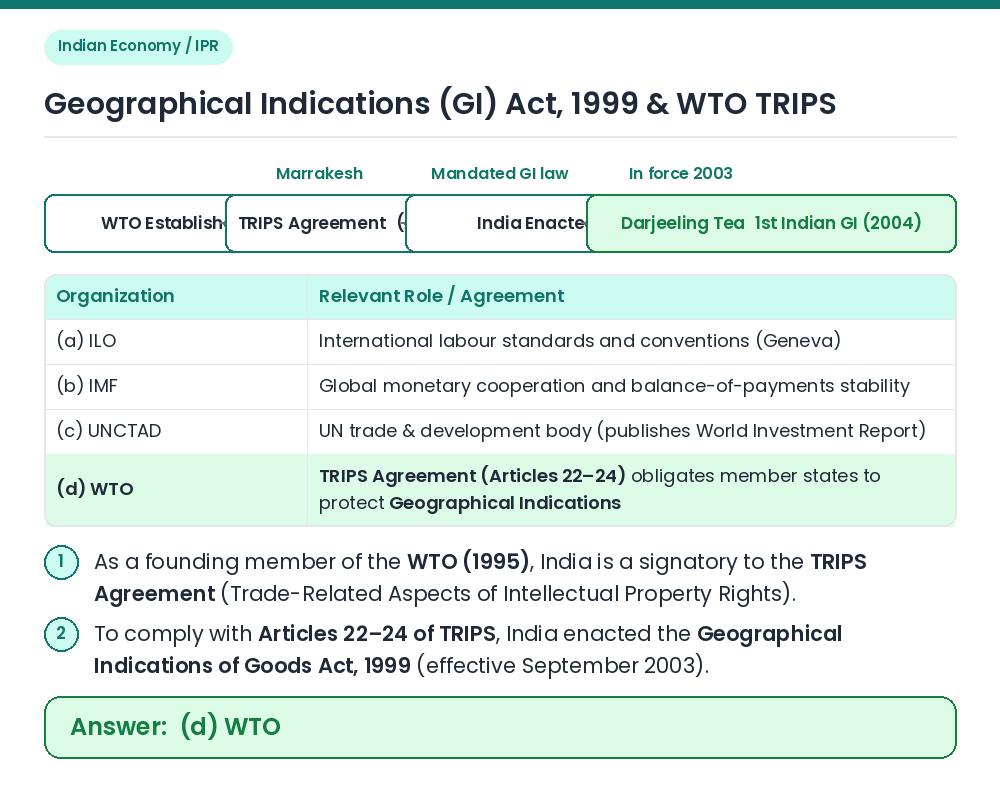
India enacted The Geographical Indications of Goods (Registration and Protection) Act, 1999 in order to comply with the obligations to
Show answer & explanationShow explanation
Answer: (D) WTO
Concept: International intellectual property obligations under the World Trade Organization (WTO) TRIPS Agreement. TRIPS Mandate: Articles 22 to 24 of the WTO Agreement on Trade-Related Aspects of Intellectual Property Rights (TRIPS) require member countries to provide legal protection for Geographical Indications (GIs). Indian Legislation: To fulfil this WTO-TRIPS obligation, Parliament enacted The Geographical Indications of Goods (Registration and Protection) Act, 1999, which came into force on 15 September 2003. Result: The Act was enacted to comply with obligations to the WTO, making option (d) correct. Related Facts: • First GI Tag in India: Darjeeling Tea became the first Indian product to receive a GI tag in 2004–05. • Validity Period: A Geographical Indication registration is valid for an initial period of 10 years and can be renewed indefinitely for further periods of 10 years each. • Nodal Authority: Administered by the Controller General of Patents, Designs and Trade Marks (under DPIIT, Ministry of Commerce and Industry), with the GI Registry located in Chennai. Correct Answer: (d) WTO