Civil Services Examination · Question 27
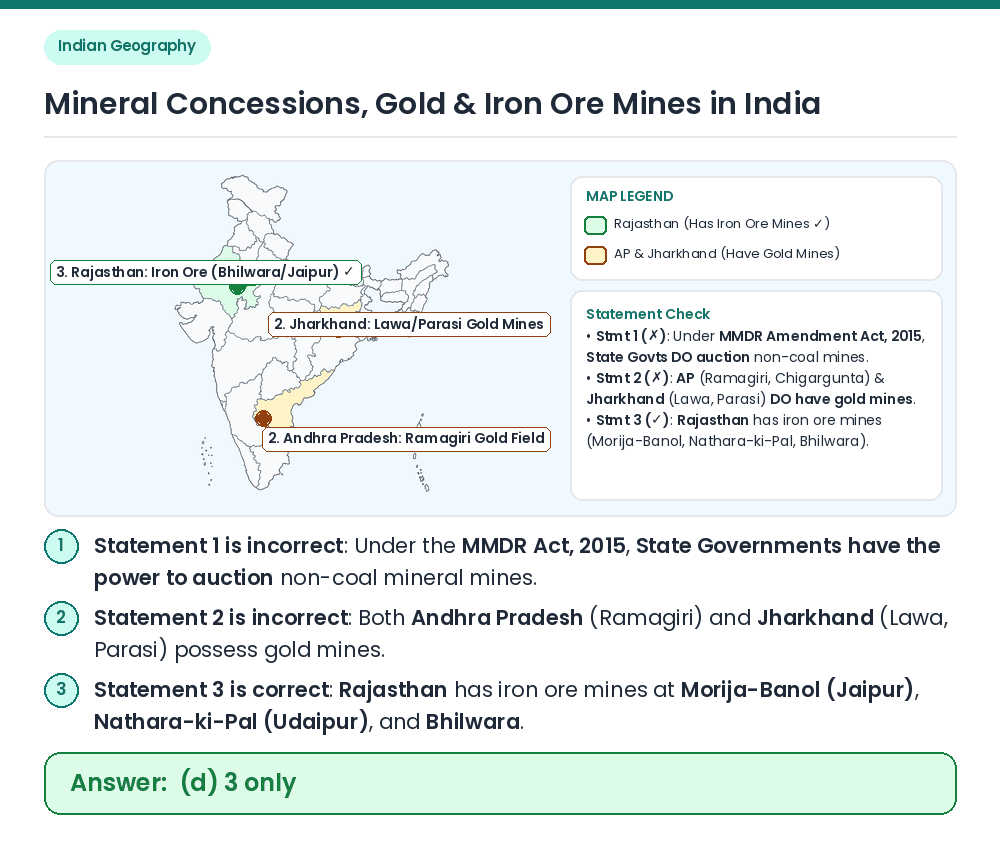
Consider the following statements : 1. In India, State Governments do not have the power to auction non-coal mines. 2. Andhra Pradesh and Jharkhand do not have gold mines. 3. Rajasthan has iron ore mines. Which of the statements given above is/are correct ?
Show answer & explanationShow explanation
Answer: (D) 3 only
Concept: Mineral auction powers under the MMDR Act and geographical distribution of gold and iron ore mines in India. Statement 1: Under the Mines and Minerals (Development and Regulation) Amendment Act, 2015, State Governments are explicitly empowered to grant mineral concessions for non-coal minerals through competitive e-auction ⇒ Statement 1 is incorrect. Statement 2: Andhra Pradesh has gold mines in Ramagiri (Anantapur district) and Chigargunta-Bisanatham (Chittoor district), while Jharkhand has gold mines in Lawa, Mysara, and Parasi (Singhbhum/Ranchi belt) ⇒ Statement 2 is incorrect. Statement 3: Rajasthan possesses magnetite and hematite iron ore deposits at Morija-Banol (Jaipur), Neemla-Raisalo (Dausa), Dabla-Singhana (Jhunjhunu), Nathara-ki-Pal and Thur-Hunder (Udaipur), and Pur-Banera (Bhilwara) ⇒ Statement 3 is correct. Result: Only statement 3 is correct, so option (d) is the right answer. Related Facts: • Coal vs Non-Coal Auctions: Coal and lignite blocks are auctioned by the Central Government (Ministry of Coal), whereas non-coal major and minor minerals are auctioned by the respective State Governments. • Gold Reserves in India: Bihar holds the largest share (~44%) of India's total gold ore resources (mostly primary ore in Jamui), while Karnataka (Hutti and Kolar fields) is the largest producer of gold metal. • District Mineral Foundation (DMF): The MMDR Amendment Act, 2015 also mandated setting up DMFs in all mining-affected districts for local area welfare. Correct Answer: (d) 3 only