Civil Services Examination · Question 38
In the Federation established by The Government of India Act of 1935, residuary powers were given to the
Show answer & explanationShow explanation
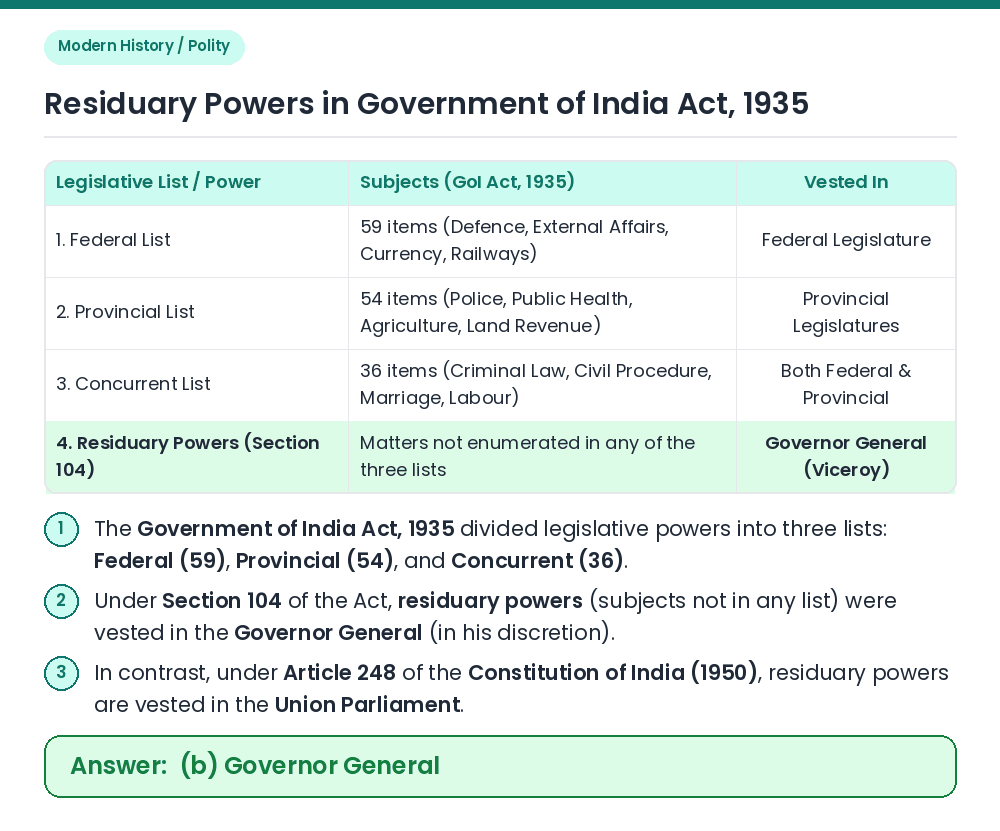
Answer: (B) Governor General
Concept: Distribution of legislative powers and allocation of residuary powers under the Government of India Act, 1935. Three Lists: The Seventh Schedule of the Government of India Act, 1935 divided subjects into three lists — Federal List (59 items), Provincial List (54 items), and Concurrent List (36 items). Residuary Powers — Section 104: Under Section 104 of the Act, residuary legislative powers (not enumerated in any of the three lists) were vested neither in the Federal Legislature nor in the Provincial Legislatures, but in the Governor General (Viceroy) acting in his discretion. Result: Residuary powers were given to the Governor General, so option (b) is correct. Related Facts: • Comparison with Present Constitution: Under Article 248 (and Entry 97 of Union List) of the Constitution of India (borrowed from the Canadian model), residuary powers are vested in the Parliament of India. •Comparison with USA & Australia: In the USA and Australia, residuary powers are vested in the States. • Other Key Features of GoI Act, 1935: Abolished dyarchy in provinces and introduced 'Provincial Autonomy', introduced dyarchy at the Centre, established a Federal Court (1937) and Reserve Bank of India (1935), and separated Burma from India. Correct Answer: (b) Governor General