Civil Services Examination · Question 40
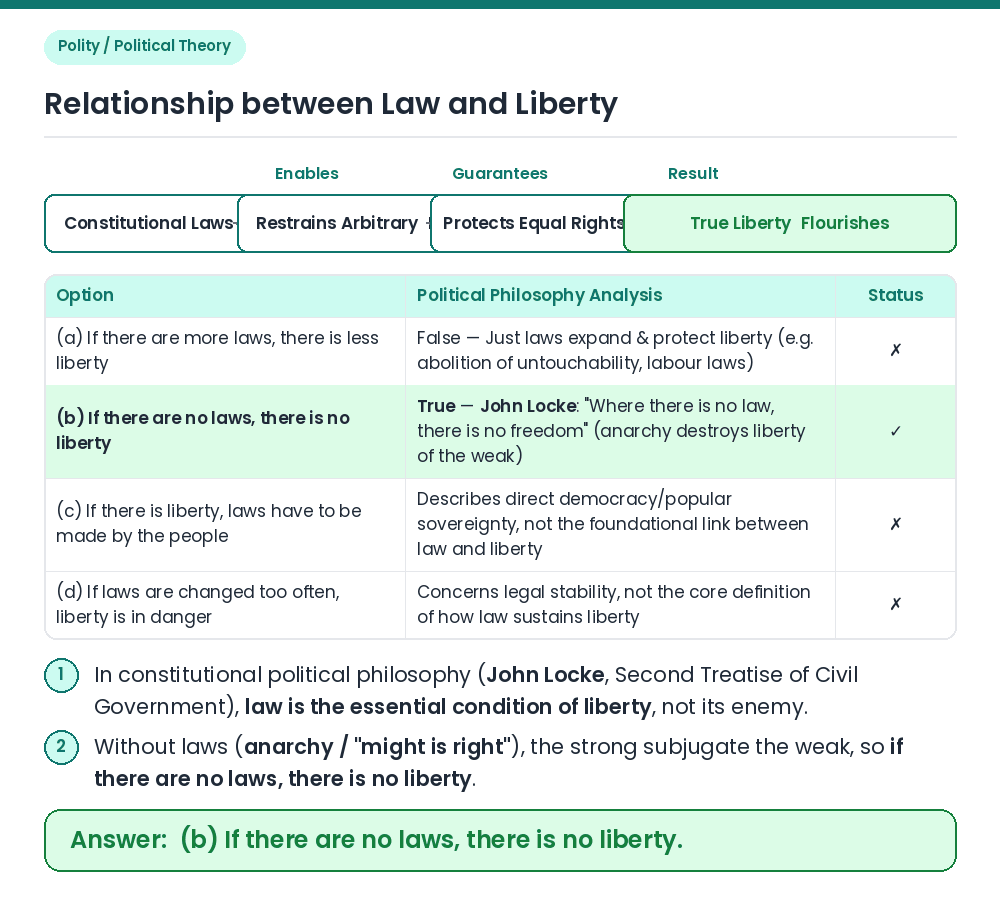
Which one of the following reflects the most appropriate relationship between law and liberty ?
Show answer & explanationShow explanation
Answer: (B) If there are no laws, there is no liberty.
Concept: Constitutional and philosophical relationship between Law and Liberty (John Locke's classical liberal principle). Philosophical Rule: In his 'Second Treatise of Civil Government' (1689), John Locke stated: 'The end of law is not to abolish or restrain, but to preserve and enlarge freedom... where there is no law, there is no freedom.' Application: In the absence of law, society reverts to a state of anarchy ('might is right') where no individual's life, rights, or liberty is secure from infringement by others ⇒ Law is the necessary condition that creates and protects liberty. Result: 'If there are no laws, there is no liberty' reflects the most appropriate relationship between law and liberty, making option (b) correct. Related Facts: • NCERT Class 11 (Political Theory — Freedom): Highlights that reasonable legal constraints are essential to prevent harm to others (J.S. Mill's 'Harm Principle') and enable everyone to enjoy liberty equally. • Indian Constitution (Articles 19 & 21): Fundamental freedoms under Article 19 are protected by law subject to 'reasonable restrictions', and Article 21 protects life and personal liberty 'according to procedure established by law'. • Ernest Barker & Laski: Both political thinkers emphasized that liberty is regulated freedom under the shelter of law. Correct Answer: (b) If there are no laws, there is no liberty.