Civil Services Examination · Question 52
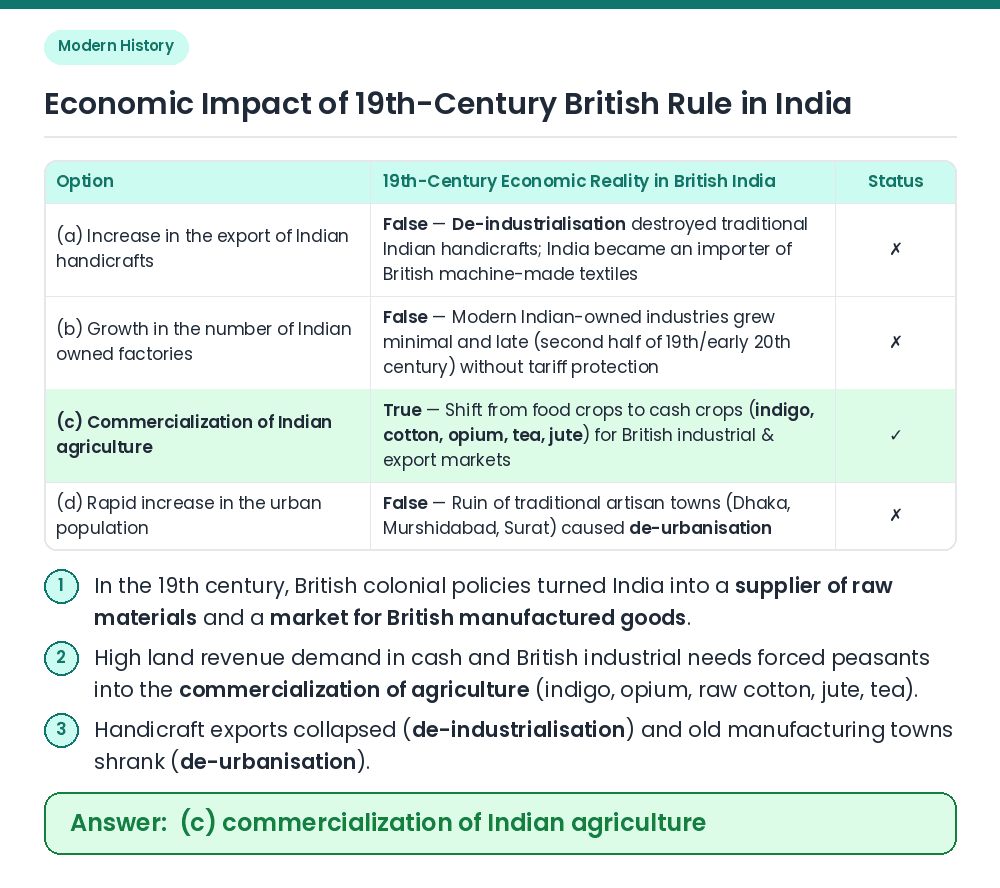
Economically, one of the results of the British rule in India in the 19th century was the
Show answer & explanationShow explanation
Answer: (C) commercialization of Indian agriculture
Concept: Structural transformation of the Indian economy during the 19th century under British colonial rule ('Colonial Economy'). Eliminate Incorrect Options: • (a) British Industrial Revolution and one-way free trade (Charter Act 1813) caused a collapse in Indian handicraft exports (de-industrialisation). • (b) Discriminatory colonial tariff and credit policies hindered the growth of Indian-owned factories. • (d) The decline of traditional handicraft centres (Dhaka, Murshidabad, Surat, Tanjore) caused a decline in urban population share (de-urbanisation). Verify Option c: High cash land-revenue assessments and British demand for industrial raw materials forced Indian peasants to cultivate commercial cash crops (indigo, cotton, opium, jute, sugarcane, tea) instead of food grains ⇒ Commercialization of Indian agriculture. Result: Commercialization of Indian agriculture was a major economic result of 19th-century British rule, making option (c) correct. Related Facts: • Forced Commercialization: For most Indian peasants, commercialization was a forced process tied to debt-cycles (tinkathia / dadni advance systems) rather than voluntary capitalist profit-seeking. • Famine Vulnerability: Shifting acreage from food grains to export cash crops reduced domestic food buffers and worsened recurring late-19th-century famines. • Drain of Wealth Theory: Expounded by Dadabhai Naoroji ('Poverty and Un-British Rule in India', 1901) and R.C. Dutt ('Economic History of India', 1902). Correct Answer: (c) commercialization of Indian agriculture