Civil Services Examination · Question 50
Despite being a high saving economy, capital formation may not result in significant increase in output due to (Italicized word: not)
Show answer & explanationShow explanation
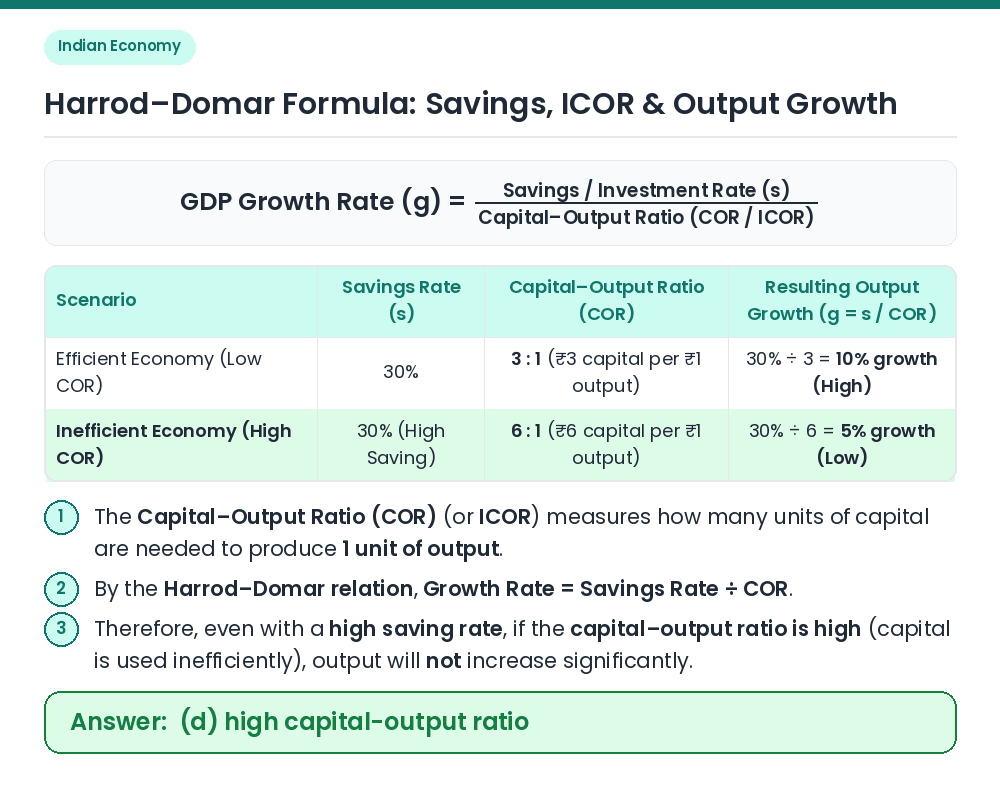
Answer: (D) high capital-output ratio
Concept: Relationship between Savings Rate (s), Capital-Output Ratio (COR / ICOR), and GDP Growth Rate (g) under the Harrod–Domar growth model. Formula: Output Growth Rate (g) = Savings/Investment Rate (s) ÷ Incremental Capital-Output Ratio (ICOR) ⇒ Capital-Output Ratio (COR) is the amount of capital required to produce one unit of output. Derivation: If COR is high (e.g., 6 units of capital needed to produce 1 unit of output instead of 3 units) ⇒ the denominator is large ⇒ even a high saving/investment rate (s) divides into a small output growth rate (g). Result: A high saving economy fails to achieve a significant increase in output due to a high capital-output ratio, making option (d) correct. Related Facts: • ICOR (Incremental Capital-Output Ratio): Defined as (ΔK / ΔY) or (Investment Rate ÷ GDP Growth Rate); a lower ICOR indicates higher productivity and efficiency of capital. • Example Calculation: At a 36% investment rate, if ICOR = 4, GDP grows at 36/4 = 9%; if ICOR rises to 6 due to project delays and inefficiency, GDP growth falls to 36/6 = 6%. • How to Lower ICOR: Improving infrastructure, reducing regulatory bottlenecks, adopting better technology, and enhancing human capital efficiency lowers ICOR. Correct Answer: (d) high capital-output ratio