Civil Services Examination · Question 46
Which one of the following statements correctly describes the meaning of legal tender money ?
Show answer & explanationShow explanation
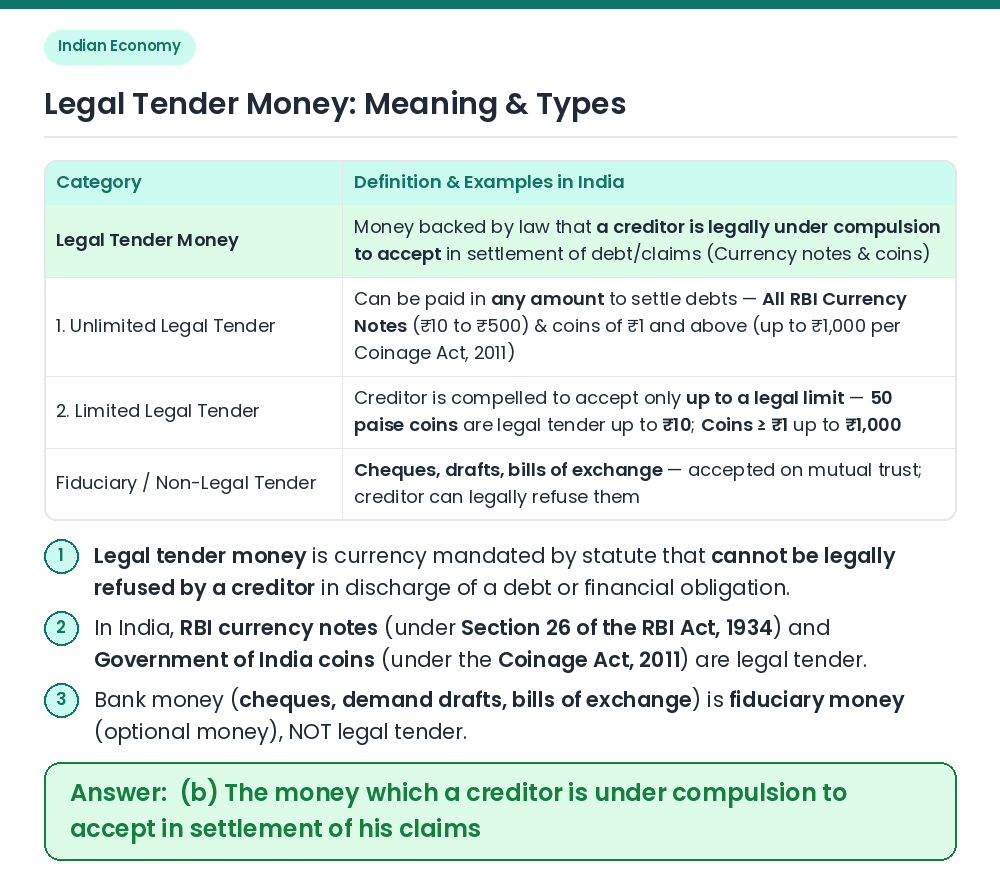
Answer: (B) The money which a creditor is under compulsion to accept in settlement of his claims
Concept: Economic and statutory definition of 'Legal Tender Money' versus fiduciary (optional) money. Definition: Legal tender is any medium of payment recognized by the law of the land that a creditor is legally compelled to accept in settlement of a monetary debt or claim. Elimination: Court fee stamps/money (a) is not the economic meaning of legal tender; cheques, drafts, and bills of exchange (c) are 'fiduciary/optional money' that a creditor can refuse; and legal tender includes both paper currency and coins, not just metallic money (d). Result: Option (b) correctly describes the meaning of legal tender money. Related Facts: • Statutory Backing in India: Under Section 26 of the RBI Act, 1934, every banknote issued by the Reserve Bank of India is legal tender throughout India; ₹1 notes and all coins are issued by the Government of India under the Coinage Act, 2011. • Limited vs Unlimited Legal Tender: Currency notes are unlimited legal tender; under the Coinage Act, 2011, coins of ₹1 and above are legal tender for any sum not exceeding ₹1,000, and 50 paise coins are legal tender up to ₹10. • Demonetisation Example: When ₹500 and ₹1,000 notes were demonetised on 8 November 2016, the Government issued a gazette notification under Section 26(2) of the RBI Act withdrawing their 'legal tender' status. Correct Answer: (b) The money which a creditor is under compulsion to accept in settlement of his claims