Civil Services Examination · Question 45
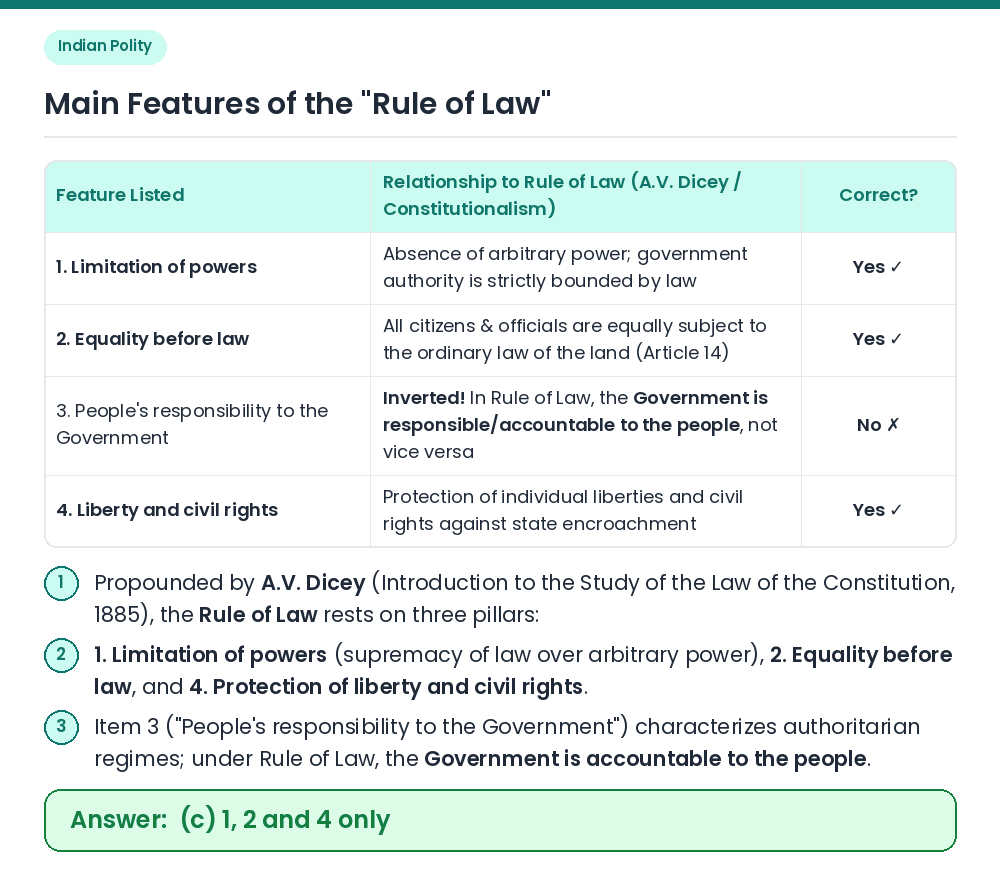
Which of the following are regarded as the main features of the "Rule of Law" ? 1. Limitation of powers 2. Equality before law 3. People's responsibility to the Government 4. Liberty and civil rights Select the correct answer using the code given below :
Show answer & explanationShow explanation
Answer: (C) 1, 2 and 4 only
Concept: Core principles of the 'Rule of Law' (Lex Rex) as formulated by British jurist A.V. Dicey and modern constitutionalism. Evaluate Features 1, 2, and 4: • 1. Limitation of powers: Absence of arbitrary power (Supremacy of Law) limits government authority ⇒ Feature of Rule of Law. • 2. Equality before law: Every person, regardless of rank or status, is subject to the ordinary law and courts (Article 14) ⇒ Feature of Rule of Law. • 4. Liberty and civil rights: Constitutional and judicial protection of individual rights and liberties (Dicey's 3rd principle: predominance of legal spirit) ⇒ Feature of Rule of Law. Evaluate Feature 3: In a constitutional democracy governed by the Rule of Law, the Government is responsible/accountable to the people and the law, NOT 'people's responsibility to the Government' ⇒ Item 3 is incorrect. Result: Features 1, 2, and 4 are the main features of the Rule of Law, making option (c) correct. Related Facts: • A.V. Dicey's Three Pillars (1885): (1) Supremacy of Law (absence of arbitrary power), (2) Equality before the Law, and (3) Predominance of Legal Spirit (constitution is the consequence of individual rights). • Indian Constitution: 'Equality before law' in Article 14 is borrowed from the British concept of Rule of Law, and the Supreme Court declared Rule of Law part of the Basic Structure (Indira Nehru Gandhi case, 1975). • Exceptions to Equality before Law: Constitutional immunities of the President/Governors (Article 361), parliamentary privileges (Articles 105 & 194), and diplomatic immunity for foreign sovereigns/ambassadors. Correct Answer: (c) 1, 2 and 4 only