Civil Services Examination · Question 44
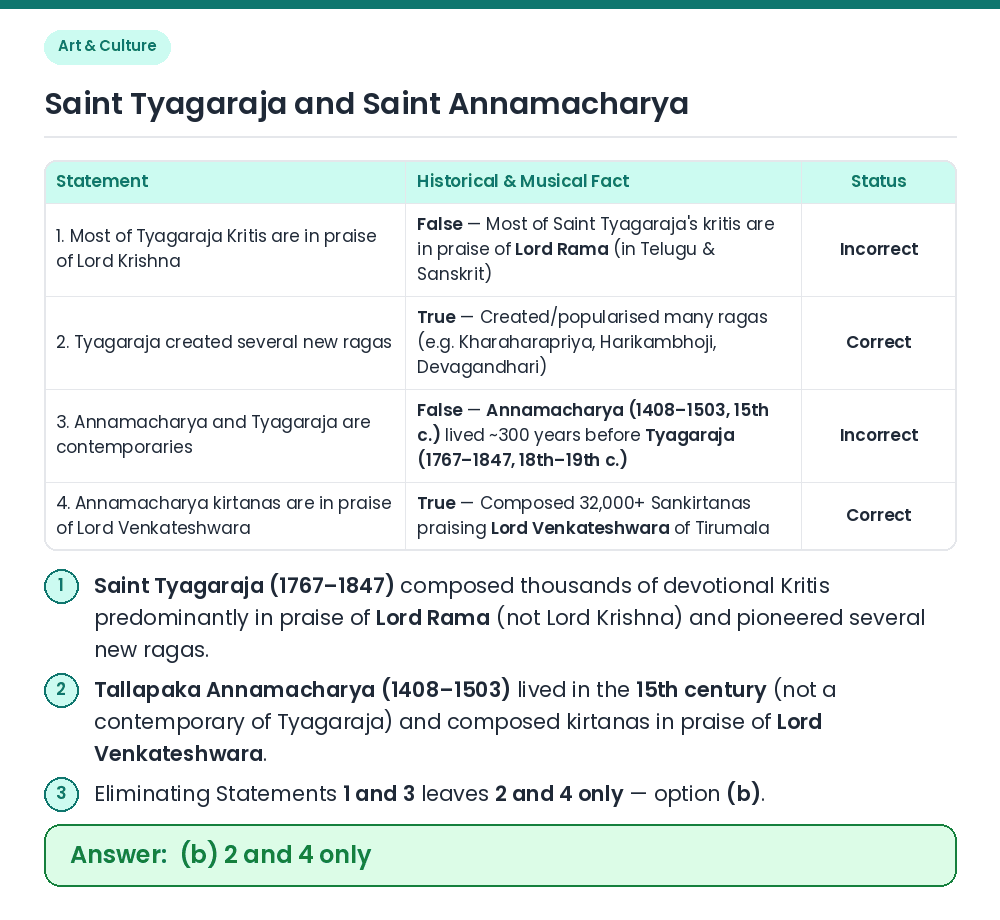
With reference to cultural history of India, consider the following statements : 1. Most of the Tyagaraja Kritis are devotional songs in praise of Lord Krishna. 2. Tyagaraja created several new ragas. 3. Annamacharya and Tyagaraja are contemporaries. 4. Annamacharya kirtanas are devotional songs in praise of Lord Venkateshwara. Which of the statements given above are correct ?
Show answer & explanationShow explanation
Answer: (B) 2 and 4 only
Concept: Contributions and eras of Carnatic music luminaries Saint Tyagaraja and Tallapaka Annamacharya. Statement 1 & Statement 2 — Saint Tyagaraja: • Saint Tyagaraja (1767–1847) was an ardent devotee of Lord Rama (not Lord Krishna); most of his kritis (including the famous 'Pancharatna Kritis') are in praise of Lord Rama ⇒ Statement 1 is incorrect. • He created and brought into prominence several new ragas in Carnatic music ⇒ Statement 2 is correct. Statement 3 & Statement 4 — Saint Annamacharya: • Tallapaka Annamacharya (1408–1503 CE) was a 15th-century Telugu saint-poet (contemporary of the Vijayanagara Sangama/Saluva era), whereas Tyagaraja lived in the late 18th and early 19th centuries (1767–1847 CE) ⇒ They were NOT contemporaries; Statement 3 is incorrect. • Annamacharya ('Pada Kavita Pitamaha') composed thousands of Sankirtanas in praise of Lord Venkateshwara of Tirupati ⇒ Statement 4 is correct. Result: Only statements 2 and 4 are correct, making option (b) the right answer. Related Facts: • Trinity of Carnatic Music: Saint Tyagaraja (1767–1847), Muthuswami Dikshitar (1775–1835), and Syama Sastri (1762–1827) — all three were born at Tiruvarur in Tamil Nadu and were contemporaries! • Copper Plates of Annamacharya: Annamacharya's Telugu Sankirtanas were engraved on copper plates and preserved in the 'Sankirtana Bhandagaram' vault at the Tirumala Venkateswara Temple. • Shortcut: Knowing that Tyagaraja worshipped Lord Rama immediately eliminates Statement 1 (ruling out options a and c), and knowing Annamacharya was a 15th-century Vijayanagara-era poet eliminates Statement 3 (ruling out d). Correct Answer: (b) 2 and 4 only