Civil Services Examination · Question 86
Why is a plant called Prosopis juliflora often mentioned in news ? (Italicized words: Prosopis juliflora)
Show answer & explanationShow explanation
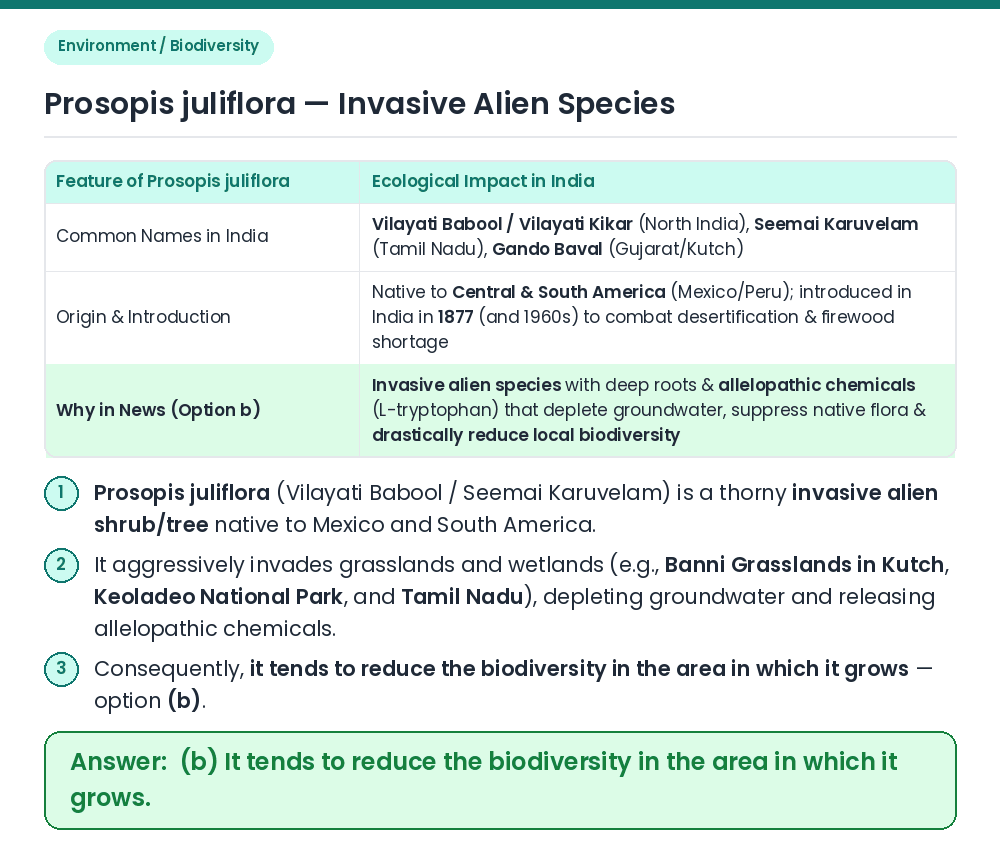
Answer: (B) It tends to reduce the biodiversity in the area in which it grows.
Concept: Ecological threat posed by Invasive Alien Species (IAS) such as Prosopis juliflora in Indian ecosystems. Identify Prosopis juliflora: Prosopis juliflora (mesquite, locally known as 'Vilayati Babool' in North India, 'Gando Baval' in Gujarat, and 'Seemai Karuvelam' in Tamil Nadu) is an exotic, drought-resistant thorny tree native to Mexico, Central America, and northern South America. Impact on Biodiversity: Introduced into arid parts of India to provide fuelwood and check soil erosion, it turned into an aggressive invasive species: its deep taproots (reaching >35–50 metres) deplete the water table, its dense canopy shades out native grasses, and its leaves release allelopathic chemicals (such as L-tryptophan) that inhibit the germination of native plants ⇒ Drastically reduces biodiversity in the area where it grows. Result: Option (b) is the exact reason why Prosopis juliflora is frequently mentioned in the news. Related Facts: • Madras High Court Order (2017): The Madurai Bench of the Madras High Court ordered the Tamil Nadu government to uproot Prosopis juliflora ('Seemai Karuvelam') across the state because it was drying up water bodies and destroying native habitats. • Threatened Indian Habitats: Severely invaded the Banni Grasslands of Kutch (Gujarat), Keoladeo Ghana National Park (Bharatpur, Rajasthan), Delhi Ridge, and Gulf of Mannar islands. • Other Major Invasive Alien Plants in India: Lantana camara, Parthenium hysterophorus (Congress grass), Eichhornia crassipes (Water hyacinth), and Senna spectabilis. Correct Answer: (b) It tends to reduce the biodiversity in the area in which it grows.