Civil Services Examination · Question 84
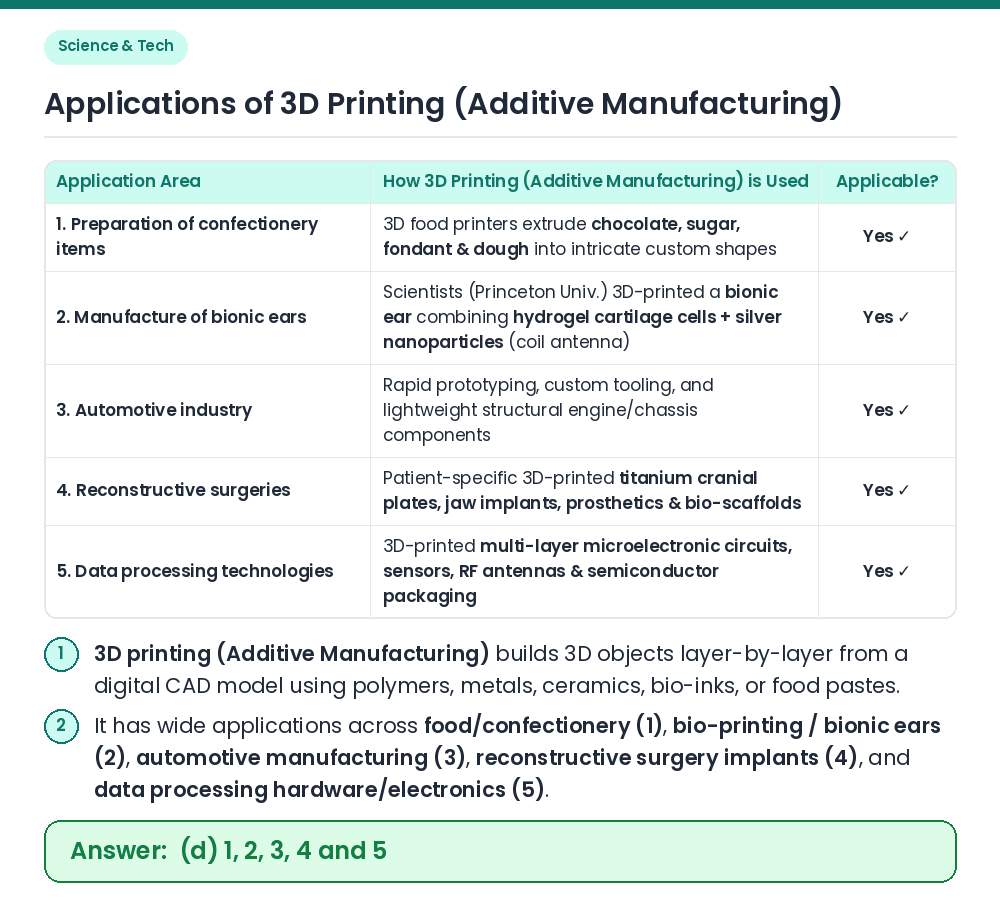
"3D printing" has applications in which of the following ? 1. Preparation of confectionery items 2. Manufacture of bionic ears 3. Automotive industry 4. Reconstructive surgeries 5. Data processing technologies Select the correct answer using the code given below :
Show answer & explanationShow explanation
Answer: (D) 1, 2, 3, 4 and 5
Concept: Broad cross-sectoral applications of 3D Printing (Additive Manufacturing). Verify Applications 1 to 4: • 1. Confectionery items: Commercial 3D food printers print intricate chocolate, sugar, candy, and pastry designs. • 2. Bionic ears: Researchers at Princeton University successfully used 3D bioprinting of cartilage cells (hydrogel matrix) infused with silver nanoparticles to create a functional 'bionic ear' capable of picking up radio/audio frequencies. • 3. Automotive industry: Used extensively for rapid prototyping and printing lightweight metal/polymer car parts. • 4. Reconstructive surgeries: Used to print patient-specific cranial, maxillofacial, dental, and orthopedic implants as well as prosthetic limbs. Verify Application 5 — Data Processing Technologies: 3D printing of embedded electronics allows printing multi-layered circuit boards, sensors, interconnects, and hardware components used in data processing systems. Result: All five applications (1, 2, 3, 4 and 5) use 3D printing, making option (d) correct. Related Facts: • Additive vs Subtractive Manufacturing: Traditional machining is 'subtractive' (carving material away from a solid block), whereas 3D printing is 'additive' (depositing material layer-by-layer from a digital STL/CAD file, minimizing waste). • 4D Printing: An extension of 3D printing using 'smart / programmable materials' (such as shape-memory polymers or hydrogels) that change their shape or properties over time in response to external stimuli (heat, moisture, light, pH). • Shortcut in Broad Application Questions: For general-purpose emerging technologies like 3D printing, AI, or nanotechnology, all listed practical engineering and medical applications are typically valid unless a statement contains a scientific impossibility. Correct Answer: (d) 1, 2, 3, 4 and 5