Civil Services Examination · Question 81
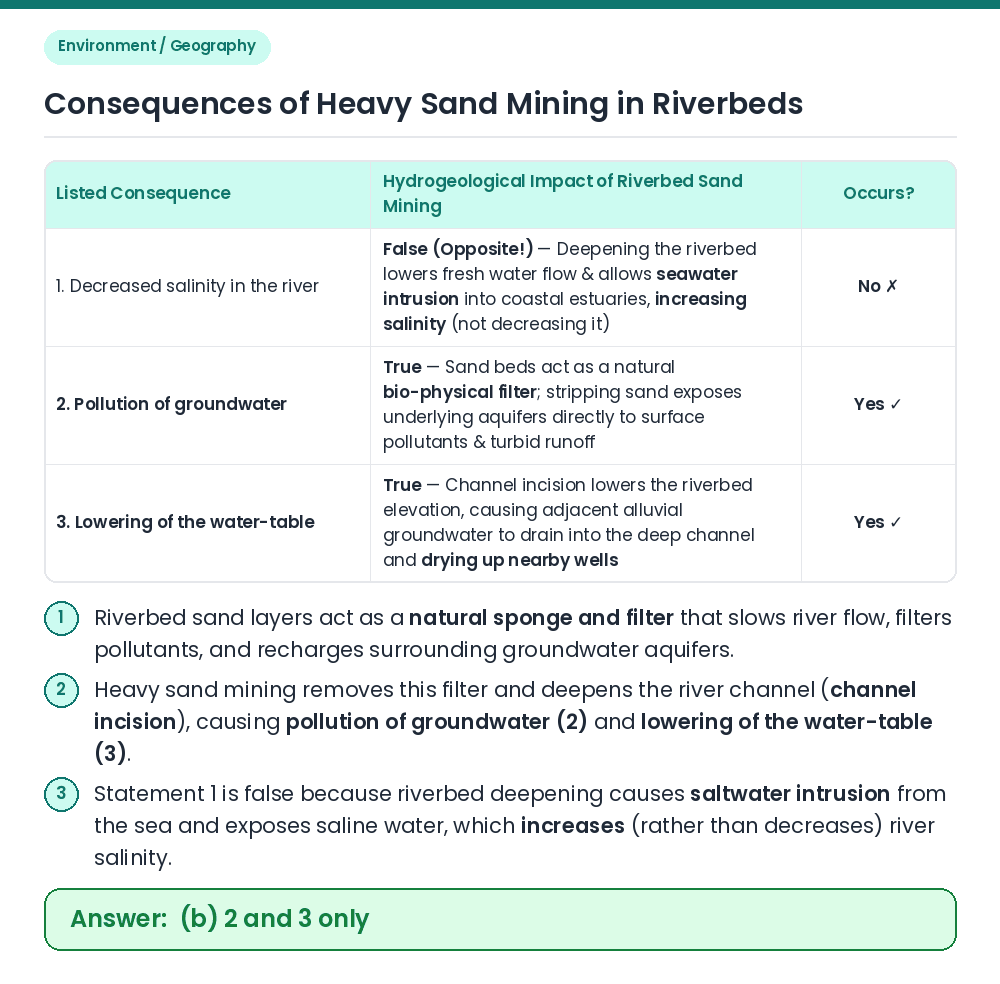
Which of the following is/are the possible consequence/s of heavy sand mining in riverbeds ? 1. Decreased salinity in the river 2. Pollution of groundwater 3. Lowering of the water-table Select the correct answer using the code given below :
Show answer & explanationShow explanation
Answer: (B) 2 and 3 only
Concept: Hydrogeological and ecological impacts of excessive instream sand and gravel mining from riverbeds. Statement 1 — Salinity: Excessive sand mining lowers the riverbed level (channel incision) below sea level in coastal reaches, causing seawater intrusion upstream into the river and coastal aquifers ⇒ This INCREASES salinity in the river, rather than decreasing it ⇒ Statement 1 is incorrect. Statement 2 — Groundwater Pollution: Thick riverbed sand deposits act as a natural filtration medium that purifies surface water percolating into underground aquifers; removing the sand layer allows untreated surface pollutants, heavy metals, and turbid water to contaminate groundwater directly ⇒ Statement 2 is correct. Statement 3 — Lowering of Water-Table: Sand beds hold water and facilitate slow percolation into floodplain aquifers; when sand is excavated and the river channel deepens, groundwater from surrounding aquifers drains into the incised river channel, lowering the local water-table and drying up wells ⇒ Statement 3 is correct. Result: Only 2 and 3 are possible consequences, making option (b) the right answer. Related Facts: • Other Impacts of Riverbed Sand Mining: Bank erosion, undermining of bridge piers and riverside structures, destruction of benthic aquatic habitats and breeding grounds of gharials, turtles, and fish. • Regulatory Guidelines: The Ministry of Environment, Forest and Climate Change (MoEFCC) issued the 'Sustainable Sand Mining Management Guidelines, 2016' and 'Enforcement & Monitoring Guidelines for Sand Mining, 2020'. • Minor Mineral Status: Under Section 3(e) of the MMDR Act, 1957, ordinary sand is classified as a 'Minor Mineral', regulated by State Governments. Correct Answer: (b) 2 and 3 only