Civil Services Examination · Question 77
Which one of the following is an artificial lake ?
Show answer & explanationShow explanation
Answer: (A) Kodaikanal (Tamil Nadu)
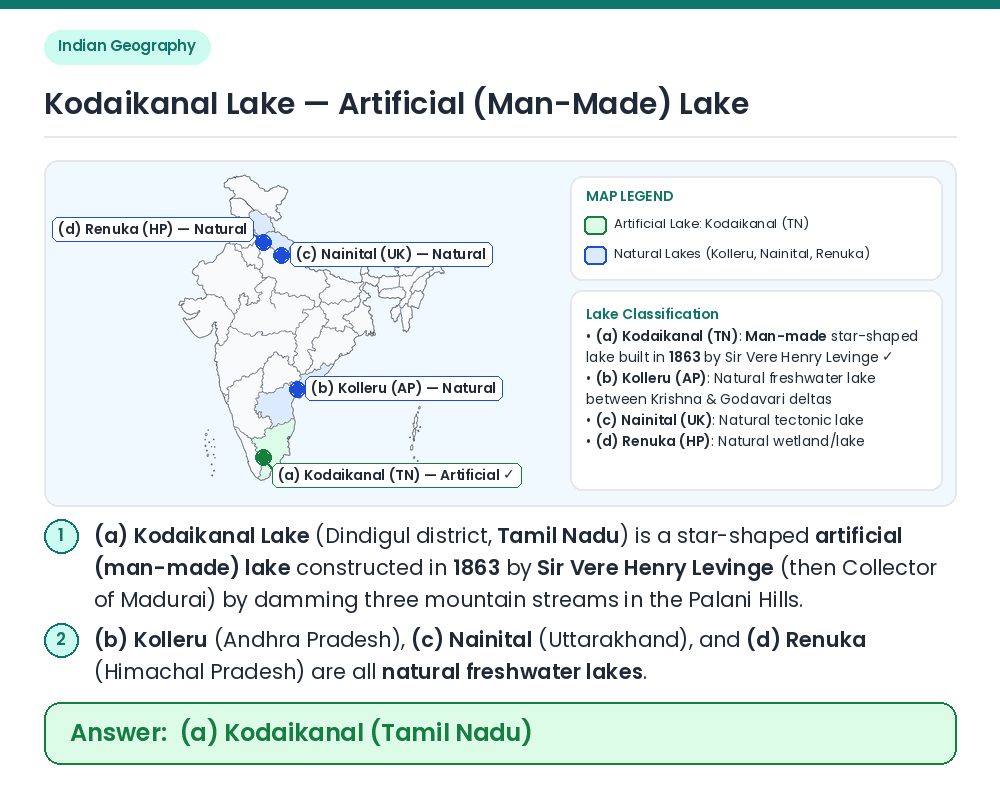
Concept: Distinguishing between artificial (man-made) lakes and natural lakes in India. Identify Kodaikanal Lake: Kodaikanal Lake, located in the Palani Hills (Dindigul district, Tamil Nadu), is a star-shaped artificial (man-made) freshwater lake created in 1863 by Sir Vere Henry Levinge, the then Collector of Madurai, by constructing an embankment across three marshy mountain streams ⇒ Option (a) is an artificial lake. Verify Other Options are Natural Lakes: • (b) Kolleru Lake (Andhra Pradesh): A large natural shallow freshwater lake situated between the Krishna and Godavari river deltas (designated a Ramsar Wetland in 2002). • (c) Nainital Lake (Uttarakhand): A natural kidney/crescent-shaped tectonic freshwater lake in the Kumaon Himalayas. • (d) Renuka Lake (Himachal Pradesh): A natural oblong freshwater lake in Sirmaur district (India's smallest Ramsar Wetland site, 20 hectares). Result: Kodaikanal (Tamil Nadu) is an artificial lake, making option (a) correct. Related Facts: • Other Major Artificial Lakes in India: Govind Ballabh Pant Sagar (Rihand Dam, UP/MP — largest artificial lake by volume), Dhebar / Jaisamand Lake (Udaipur, Rajasthan — built by Maharana Jai Singh in 1685), Bhojtal / Upper Lake (Bhopal, MP — built by Raja Bhoja in 11th century), Hussain Sagar (Hyderabad), and Ooty Lake (Tamil Nadu, built by John Sullivan in 1824). • Unique Flora of Kodaikanal: Surrounded by Shola forests and famous for the 'Kurinji' (Strobilanthes kunthiana) flower that blooms once every 12 years. Correct Answer: (a) Kodaikanal (Tamil Nadu)