Civil Services Examination · Question 76
Which of the following led to the introduction of English Education in India ? 1. Charter Act of 1813 2. General Committee of Public Instruction, 1823 3. Orientalist and Anglicist Controversy Select the correct answer using the code given below :
Show answer & explanationShow explanation
Answer: (D) 1, 2 and 3
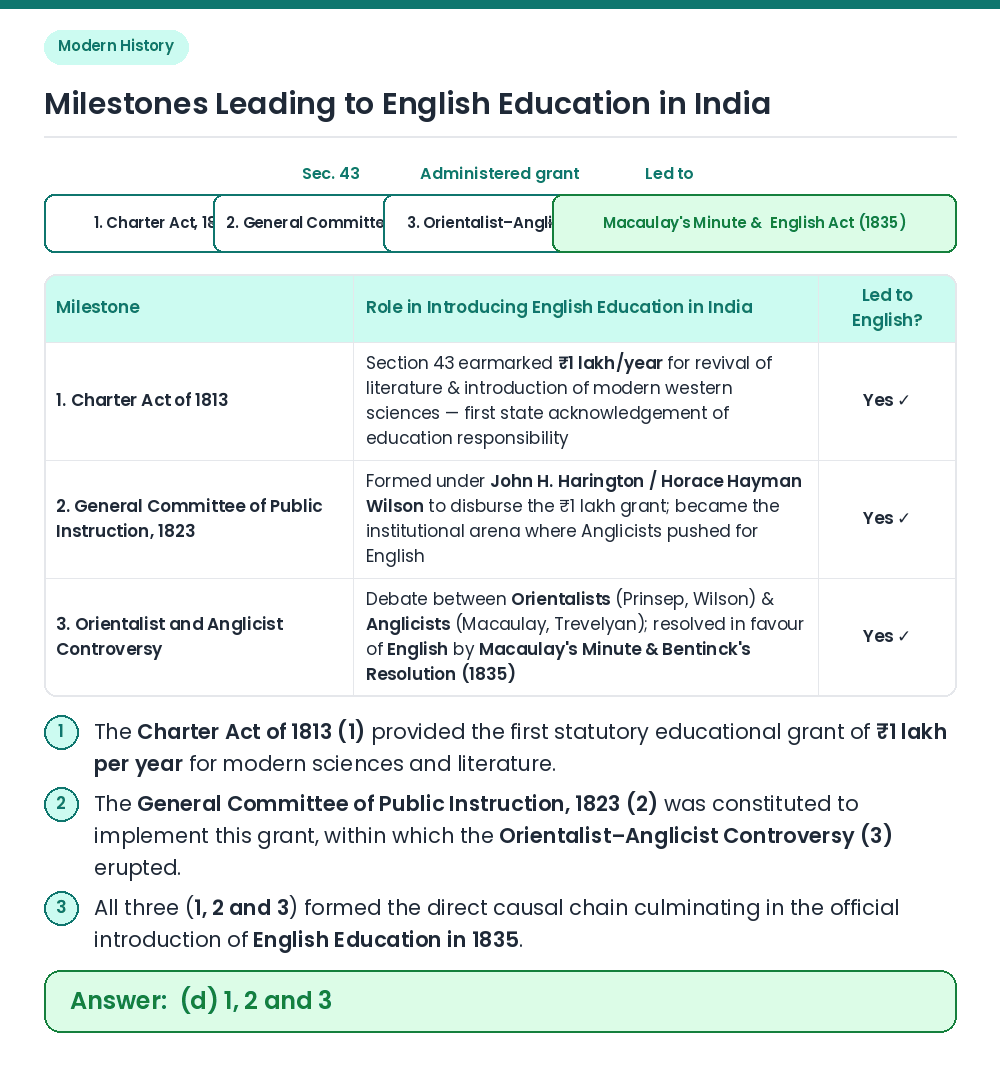
Concept: Chronological chain of legislative and administrative developments that led to the introduction of English Education in colonial India. Item 1 — Charter Act of 1813: Section 43 of the Charter Act of 1813 directed the East India Company to set apart ₹1 lakh annually for the revival of literature and for the introduction and promotion of a knowledge of the sciences among the inhabitants of British India ⇒ Initiated state-funded modern/English education. Item 2 — General Committee of Public Instruction, 1823: Appointed in July 1823 by Governor-General John Adam to utilize the ₹1 lakh grant and guide Company educational policy ⇒ Provided the institutional framework. Item 3 — Orientalist and Anglicist Controversy: A sharp split within the 10-member General Committee between Orientalists (who favoured Sanskrit/Arabic/Persian) and Anglicists (who favoured English as the medium for western sciences) was decided in favour of the Anglicists via Lord Macaulay's Minute (2 Feb 1835) and Lord William Bentinck's English Education Act (7 March 1835). Result: All three (1, 2 and 3) led to the introduction of English Education in India, making option (d) correct. Related Facts: • Orientalists vs Anglicists: Key Orientalists included H.T. Prinsep and H.H. Wilson; key Anglicists included Thomas Babington Macaulay, Charles Trevelyan, and Raja Ram Mohan Roy (who advocated modern western sciences in English). • Downward Filtration Theory: Propounded by Macaulay, proposing to educate a small upper/middle class in English who would be 'Indian in blood and colour, but English in taste, in opinions, in morals, and in intellect'. • Replacement of Persian (1837): In 1837, English and vernacular languages replaced Persian as the official language of higher courts and administration. Correct Answer: (d) 1, 2 and 3