Civil Services Examination · Question 72
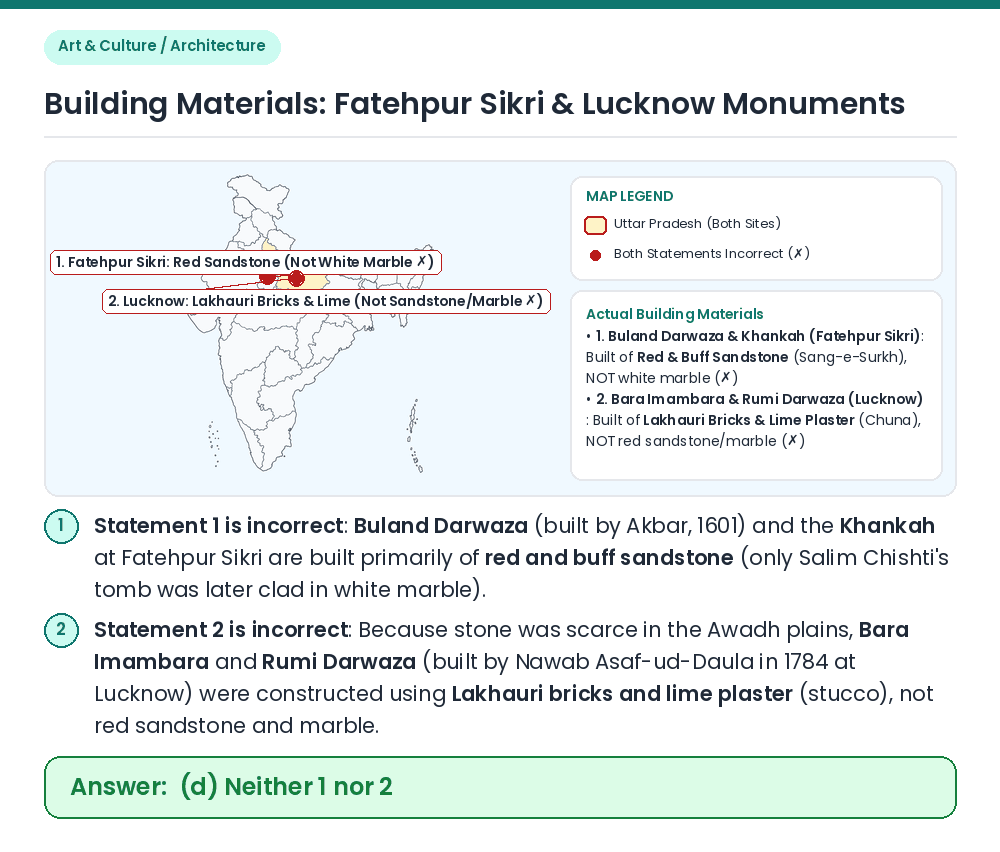
With reference to the cultural history of India, consider the following statements : 1. White marble was used in making Buland Darwaza and Khankah at Fatehpur Sikri. 2. Red sandstone and marble were used in making Bara Imambara and Rumi Darwaza at Lucknow. Which of the statements given above is/are correct ?
Show answer & explanationShow explanation
Answer: (D) Neither 1 nor 2
Concept: Architectural materials used in Mughal monuments at Fatehpur Sikri versus Nawabi (Awadh) monuments at Lucknow. Statement 1 — Fatehpur Sikri: Emperor Akbar built Fatehpur Sikri (including the Buland Darwaza and the Khankah/hospice) primarily out of locally quarried red and buff sandstone ('Sang-e-Surkh') with minimal marble inlay; only the Tomb of Shaikh Salim Chishti inside the courtyard was later encased in white marble during Jahangir's reign ⇒ Statement 1 is incorrect. Statement 2 — Lucknow Monuments: Built by Nawab Asaf-ud-Daula of Awadh in 1784 (as a famine-relief project), the Bara Imambara and the Rumi Darwaza in Lucknow were constructed WITHOUT red sandstone or marble; due to the absence of stone quarries in the alluvial Gangetic plains, Awadh architects used small kiln-baked 'Lakhauri bricks' covered with lime mortar and intricate stucco plaster (chuna/gach) ⇒ Statement 2 is incorrect. Result: Neither statement 1 nor statement 2 is correct, making option (d) the right answer. Related Facts: • Notice the Swap: The question deliberately swapped the materials! Red sandstone (with minor marble inlay) was used at Fatehpur Sikri, whereas brick and lime plaster (which gives a white/cream appearance) was used at Lucknow. • Buland Darwaza (54 m high): Highest gateway in the world, built by Akbar at Fatehpur Sikri to commemorate his victory over Gujarat (1573–1601). • Bara Imambara ('Asafi Imambara'): Designed by architect Kifayatullah, its central vaulted hall (50 m × 16 m) is one of the largest arched halls in the world built without any wooden or iron beams, topped by the famous 'Bhool Bhulaiya' labyrinth. Correct Answer: (d) Neither 1 nor 2