Civil Services Examination · Question 69
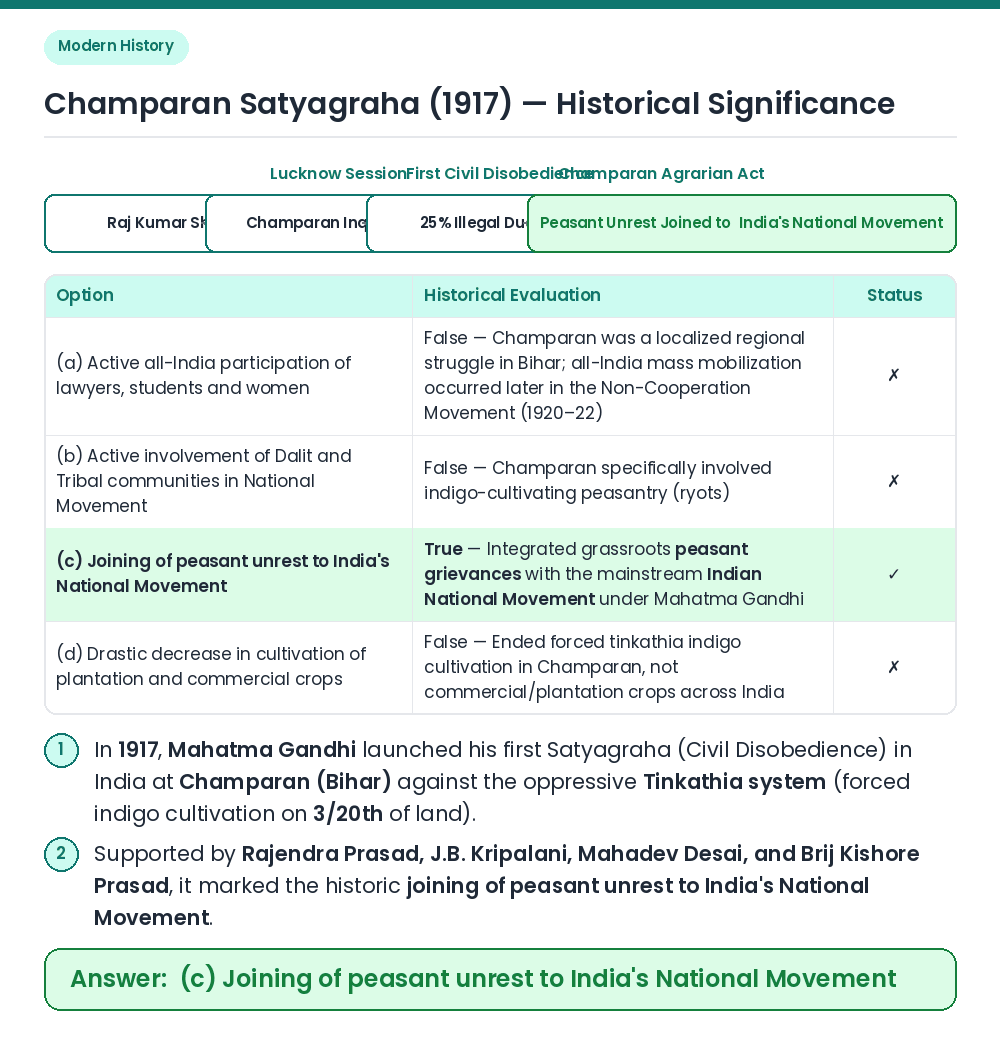
Which one of the following is a very significant aspect of the Champaran Satyagraha ?
Show answer & explanationShow explanation
Answer: (C) Joining of peasant unrest to India's National Movement
Concept: Historical significance of the Champaran Satyagraha (1917), Mahatma Gandhi's first Satyagraha in India. Historical Context: At the invitation of peasant leader Raj Kumar Shukla (at the 1916 Lucknow Congress Session), Mahatma Gandhi went to Champaran (Bihar) in April 1917 to investigate the exploitation of indigo peasants under the 'Tinkathia' system (which forced peasants to cultivate indigo on 3/20th of their land for European planters and pay illegal abwabs/sharahbeshi). Core Significance: By bringing urban nationalist intelligentsia (Rajendra Prasad, Brij Kishore Prasad, Mazharul Haque, J.B. Kripalani, Narhari Parikh, Mahadev Desai) to champion rural peasant grievances, the Champaran Satyagraha bridged political nationalism with agrarian struggles, resulting in the joining of peasant unrest to India's National Movement. Result: Option (c) captures the most significant aspect of the Champaran Satyagraha. Related Facts: • Champaran Agrarian Act (1918): Based on the inquiry committee report (in which Gandhi served as a member), the Tinkathia system was abolished and European planters agreed to refund 25% of the money illegally exacted from peasants. • Gandhi's Early Trio of Struggles (1917–1918): (1) Champaran Satyagraha (1917) — First Civil Disobedience, (2) Ahmedabad Mill Strike (Feb–Mar 1918) — First Hunger Strike, and (3) Kheda Satyagraha (1918) — First Non-Cooperation. • Title 'Mahatma': During this period, Rabindranath Tagore conferred the title of 'Mahatma' on Gandhi. Correct Answer: (c) Joining of peasant unrest to India's National Movement