Civil Services Examination · Question 68
The staple commodities of export by the English East India Company from Bengal in the middle of the 18th century were
Show answer & explanationShow explanation
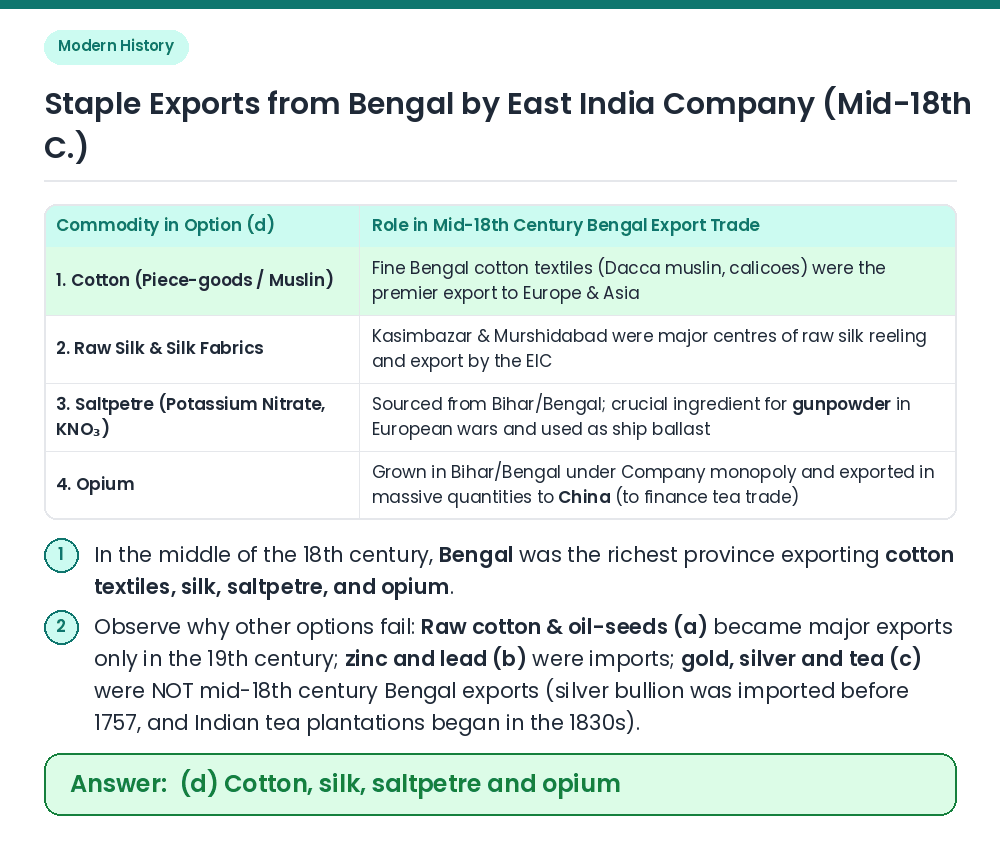
Answer: (D) Cotton, silk, saltpetre and opium
Concept: Composition of the English East India Company's export trade from the Bengal Subah during the mid-18th century (1750s). Identify the Four Staple Exports: • Cotton and Silk: Bengal was world-famous for fine cotton piece-goods (muslins, calicoes) and raw/woven silk (Kasimbazar, Malda). • Saltpetre (Potassium nitrate, KNO₃): Produced abundantly in Bihar (Patna) and shipped via Bengal; essential for manufacturing gunpowder in Europe and used as heavy ballast in EIC ships. • Opium: Monopolized by the Company in Bihar/Bengal and exported to China and Southeast Asia to finance the Company's purchase of Chinese tea. Eliminate Other Options: • Option (a): Raw cotton and oil-seeds became major exports only after the Industrial Revolution in the 19th century. • Option (b): Zinc and lead were imported into India, not exported. • Option (c): Gold and silver (bullion) were imported into Bengal before Plassey (1757) to pay for Indian goods, and tea cultivation in India started only in the 1830s. Result: Cotton, silk, saltpetre, and opium were the staple exports from Bengal in the mid-18th century, making option (d) correct. Related Facts: • Pre-1757 vs Post-1757 Trade Shift: Before the Battle of Plassey (1757), the EIC imported silver bullion from Europe to buy Bengal cotton and silk; after gaining the Diwani of Bengal (1765), the Company used Bengal's land revenue surplus ('Investment') to buy these exports for free. • Saltpetre Centres: Patna (Bihar) was the principal mart for saltpetre, where English, Dutch, and French Companies established factories. • Triangular Trade: Bengal opium was exported to China in exchange for Chinese tea shipped to Britain. Correct Answer: (d) Cotton, silk, saltpetre and opium