Civil Services Examination · Question 66
When the alarm of your smartphone rings in the morning, you wake up and tap it to stop the alarm which causes your geyser to be switched on automatically. The smart mirror in your bathroom shows the day's weather and also indicates the level of water in your overhead tank. After you take some groceries from your refrigerator for making breakfast, it recognises the shortage of stock in it and places an order for the supply of fresh grocery items. When you step out of your house and lock the door, all lights, fans, geysers and AC machines get switched off automatically. On your way to office, your car warns you about traffic congestion ahead and suggests an alternative route, and if you are late for a meeting, it sends a message to your office accordingly. In the context of emerging communication technologies, which one of the following terms best applies to the above scenario ?
Show answer & explanationShow explanation
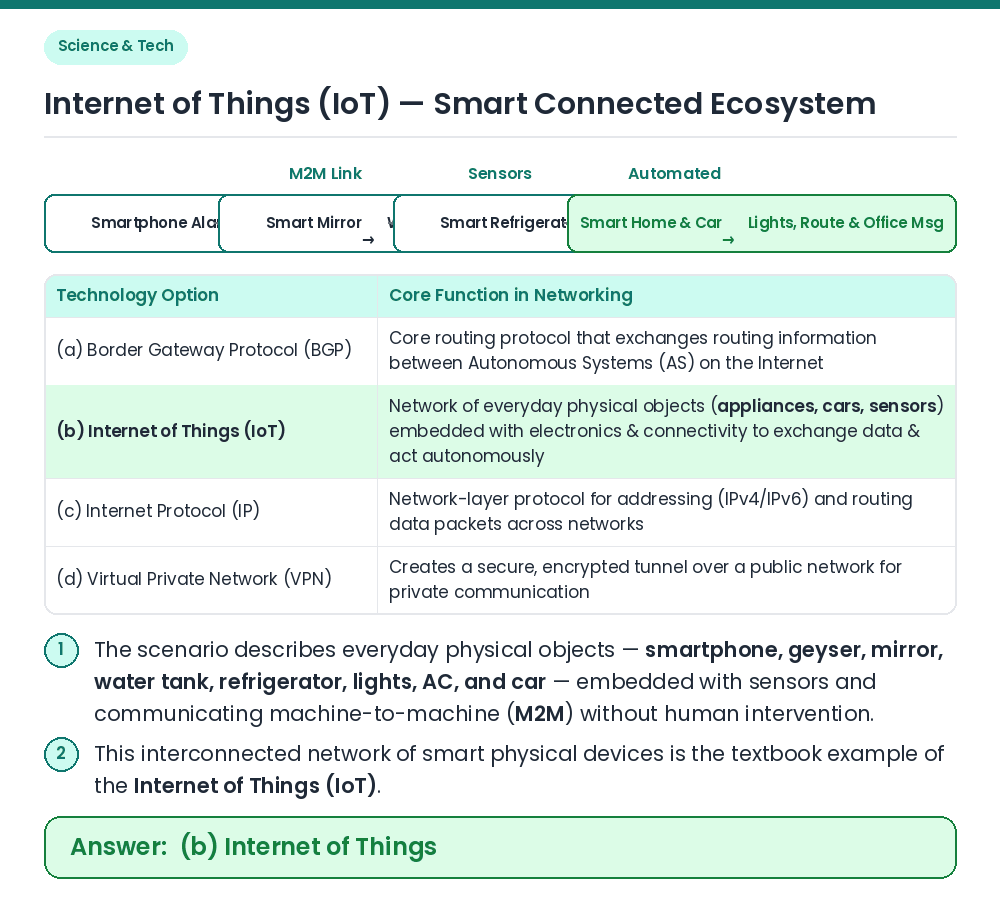
Answer: (B) Internet of Things
Concept: Real-world smart home and connected-vehicle applications of the Internet of Things (IoT). Analyze the Scenario: Everyday physical appliances (smartphone, geyser, mirror, water tank sensor, refrigerator, lights, AC, door lock, and car) are equipped with sensors, software, and network connectivity, allowing them to collect data and communicate machine-to-machine (M2M) to automate actions. Match to Term: This network of interconnected physical objects ('things') that exchange data over the internet without requiring human-to-human or human-to-computer interaction is defined as the 'Internet of Things (IoT)'. Result: Option (b) Internet of Things best applies to the given scenario. Related Facts: • Coining of the Term: The term 'Internet of Things' was coined by British technology pioneer Kevin Ashton in 1999 while working on RFID supply-chain tracking. • Key Enabling Technologies of IoT: RFID tags, low-power sensors/actuators, IPv6 (which provides 2^128 unique IP addresses for billions of devices), 5G low-latency networks, Cloud/Edge computing, and AI. • Other Options: Border Gateway Protocol (BGP) routes traffic between internet service providers (ISPs); Internet Protocol (IP) addresses packets; VPN encrypts internet connections. Correct Answer: (b) Internet of Things